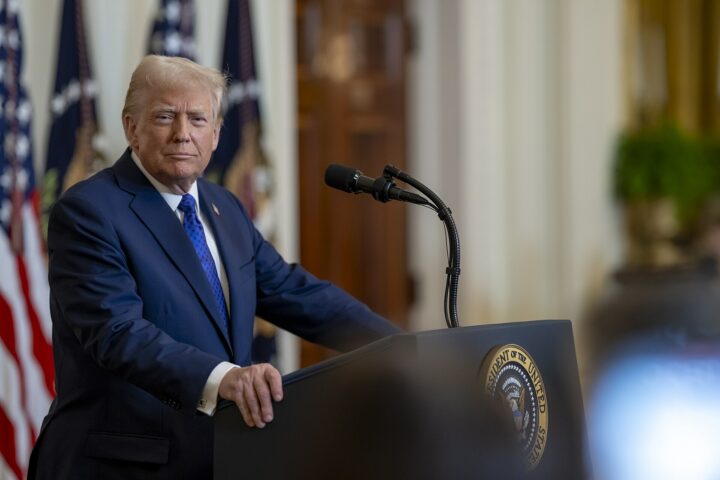
President Donald Trump convened the inaugural meeting of his newly established Board of Peace on Thursday, outlining a multibillion-dollar international effort aimed at stabilizing and rebuilding Gaza following a fragile ceasefire.
Meeting at the U.S. Institute of Peace, Trump said nine member countries — Kazakhstan, Azerbaijan, the United Arab Emirates, Morocco, Bahrain, Qatar, Saudi Arabia, Uzbekistan, and Kuwait — have collectively pledged more than $7 billion toward a relief package for the war-devastated Palestinian territory. He characterized the commitments as meaningful investments in long-term regional stability and future harmony, noted The Associated Press.
Trump also announced that the United States would commit $10 billion to the Board of Peace. He did not provide detailed specifics regarding how the American funds would be allocated or distributed.
Even combined, the pledges remain well below the estimated $70 billion that analysts say will be required to fully rebuild Gaza after months of sustained conflict.
Security arrangements were also a central focus of the meeting. Maj. Gen. Jasper Jeffers, commander of the newly formed International Stabilization Force, reported progress in assembling a multinational presence to help maintain order and oversee post-conflict stabilization.
Indonesia, Morocco, Kazakhstan, Kosovo, and Albania have pledged to contribute thousands of troops to the force, Jeffers said. Egypt and Jordan — both of which border Gaza — have agreed to assist in training local police and security personnel.
“With these first steps, we help bring the security that Gaza needs for a future of prosperity and enduring peace,” Jeffers said.
The Board of Peace was initially conceived as part of Trump’s broader 20-point plan to resolve the Gaza conflict. Administration officials now describe it as a more expansive initiative that could address not only a lasting settlement between Israel and Hamas but also broader global conflicts. Trump has positioned the board as a potential alternative to traditional United Nations mechanisms, arguing that a coalition-driven framework may prove more flexible and effective.
A full list of countries that have joined the board includes Argentina, Albania, Armenia, Azerbaijan, Bahrain, Belarus, Bulgaria, Cambodia, Egypt, El Salvador, Hungary, Indonesia, Jordan, Kazakhstan, Kuwait, Kosovo, Morocco, Mongolia, Pakistan, Paraguay, Qatar, Saudi Arabia, Turkey, the United Arab Emirates, Uzbekistan, and Vietnam. Some nations have declined to participate or remain undecided.
Despite the early diplomatic momentum, major obstacles remain. The disarmament of Hamas continues to be a core Israeli requirement tied to maintaining the ceasefire. While the proposed armed international force is intended to help oversee demilitarization and preserve order, troop commitments remain limited, and Hamas has thus far shown reluctance to engage on disarmament terms.
The gathering drew representatives from more than 40 countries, reflecting the administration’s effort to consolidate international backing for its postwar vision for Gaza at a moment when both the ceasefire and the reconstruction process remain uncertain.