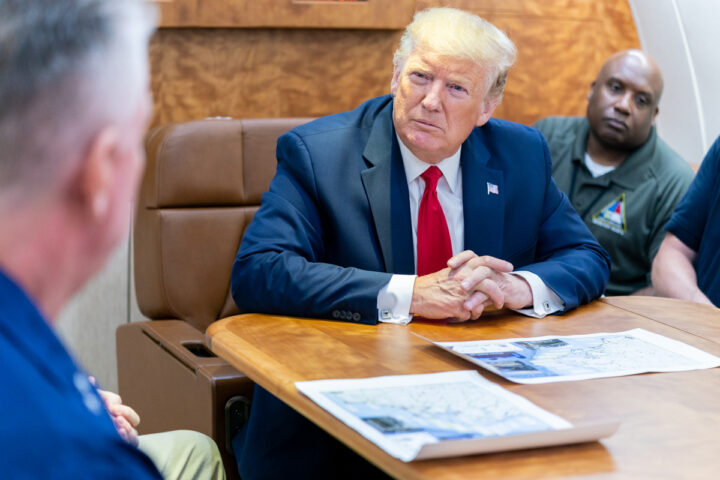
President Donald Trump sharply criticized a top counterterrorism official who resigned Tuesday in protest over the administration’s war with Iran, dismissing the appointee as “weak” and declaring his departure a positive development.
Speaking at the White House alongside Irish Prime Minister Micheál Martin during St. Patrick’s Day events, Trump was asked about the sudden resignation of Joe Kent, the director of the National Counterterrorism Center. Kent stepped down earlier in the day, citing deep objections to the ongoing conflict.
“I always thought he was weak on security, very weak on security,” Trump said. “It’s a good thing that he’s out.”
The president added that he did not know Kent well personally, but said the official’s public resignation statement reinforced his view. Trump took particular issue with Kent’s assertion that Iran did not pose an imminent threat to the United States.
“Iran was a threat,” Trump said. “Every country realized what a threat Iran was. The question was whether or not they wanted to do something about it.”
Kent’s resignation letter, which he released publicly, offered a starkly different perspective — one that underscores growing divisions even among those who once supported the president’s foreign policy approach.
“After much reflection, I have decided to resign,” Kent wrote, stating that he could not “in good conscience support the ongoing war in Iran.” He argued that Iran did not pose an immediate danger to the United States and suggested that the conflict was driven by outside pressure rather than direct national interest.
In his letter, Kent pointed back to Trump’s earlier campaigns and first term, praising what he described as an “America First” approach that avoided prolonged entanglements overseas. He credited Trump with demonstrating how to use military force decisively without becoming drawn into extended conflicts, citing actions such as the killing of Qasam Solamani and the defeat of ISIS.
At the same time, Kent warned that the current trajectory risked repeating past mistakes. He wrote that early in the administration, a “misinformation campaign” by foreign officials and elements of the American media contributed to pro-war sentiment and influenced decision-making around Iran.
Kent compared the situation to the lead-up to the Iraq war, describing it as a cautionary example of how the United States can be drawn into costly and protracted conflicts. He argued that such wars have historically come at a steep price, both in American lives and national resources.
His objections were also deeply personal. A veteran Army Ranger who served 11 combat tours, largely in Iraq, Kent emphasized his experience with the human cost of war. He also referenced the loss of his wife, Shannon, who was killed in a 2019 suicide bombing in Syria, an event that shaped his political outlook.
“As a veteran… and as a Gold Star husband,” Kent wrote, he could not support sending more Americans into a conflict he believes does not justify the sacrifice.
Despite the strong language from both sides, the exchange highlights a broader debate that continues to surface during times of military action: how to weigh perceived threats against the long-term consequences of war.
Trump has made clear he views Iran as a serious danger requiring decisive action. But Kent’s resignation — and the reasoning behind it — serves as a reminder that even within an administration committed to projecting strength, questions remain about the costs, motivations, and potential outcomes of another conflict in the Middle East.
As the war continues, those tensions may only grow more difficult to ignore.
[READ MORE: Kushner’s Dual Roles Draw Scrutiny as He Seeks Billions While Serving as Trump Envoy]