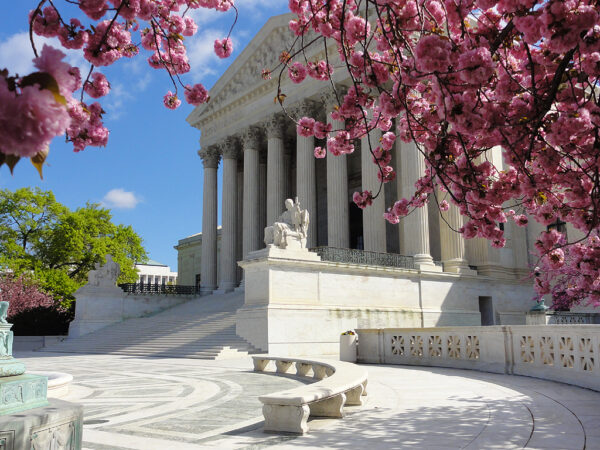
More than $175 billion in U.S. tariff revenue could potentially be refunded following the Supreme Court’s decision to strike down President Donald Trump’s sweeping emergency tariffs, according to economists with the Penn Wharton Budget Model (PWBM), a fiscal research group at the University of Pennsylvania.
The economists’ analysis, first reported by Reuters, indicates that while the Court’s 6-3 ruling does not explicitly order refunds, it opens the door for importers to seek them. Under current procedures, companies have a 180-day window after goods are “liquidated” to file protests and request refunds from U.S. Customs and Border Protection.
PWBM Director Kent Smetters told Reuters that most companies are likely to pursue refunds, which would ultimately be paid out by the U.S. Treasury Department.
The $175 billion estimate is based on tariff rates applied by product and country, including those imposed under Trump’s use of the International Emergency Economic Powers Act. According to CBP data cited in the report, the agency collected approximately $133.5 billion in tariffs under IEEPA authority as of December 2025.
Trump made history by becoming the first president in nearly 50 years to attempt to use IEEPA to impose tariffs. The statute allows the president to regulate imports in response to national emergencies presenting an “unusual and extraordinary” threat.
The Supreme Court’s ruling rejected the administration’s reliance on IEEPA for the sweeping tariff policy. However, the justices did not directly address how refund claims should be handled.
Justice Brett Kavanaugh, dissenting along with Justices Clarence Thomas and Samuel Alito, was the only member of the Court to highlight the looming refund battle.
“One issue will be refunds,” Kavanaugh wrote. “Refunds of billions of dollars would have significant consequences for the U.S. Treasury. The Court says nothing today about whether, and if so how, the Government should go about returning the billions of dollars that it has collected from importers.”
The refund question is expected to be addressed in lower courts, where ongoing litigation is likely to resume. Hundreds of companies have already filed lawsuits asserting their right to reclaim tariff payments. Major retailers and brands, including Costco, Barnes & Noble, Bath & Body Works, and Yeti, were among those closely watching the Court’s decision.
Previously, Trump floated the idea of using tariff revenue to benefit Americans directly. Last year, he told companies and small businesses that collected funds could be returned in the form of rebate payments.
Following the ruling, Trump sharply criticized the six justices in the majority — including Chief Justice John Roberts and Trump appointees Neil Gorsuch and Amy Coney Barrett — calling them “very unpatriotic and disloyal to our Constitution.” He praised Kavanaugh, Thomas, and Alito for what he described as their “strength and wisdom and love of our country.”
Despite the setback, the president signaled he would not abandon his trade agenda. Trump said he plans to raise preexisting tariffs, pursue new ones, and launch investigations that could lead to additional import taxes on a broad range of countries and goods.
He pointed to Section 301 of the Trade Act of 1974, which allows the Office of the U.S. Trade Representative to impose tariffs on countries found to have engaged in “discriminatory” or “unfair” trade practices. U.S. Trade Representative Jamieson Greer told The New York Times last month that the administration could also act under the same law to address “large and serious United States balance-of-payment deficits.”
Trump said Friday that he intends to impose 10 percent global tariffs under that statute, “over and above our normal tariffs already being charged,” signaling that the legal battle over tariffs may be far from over.