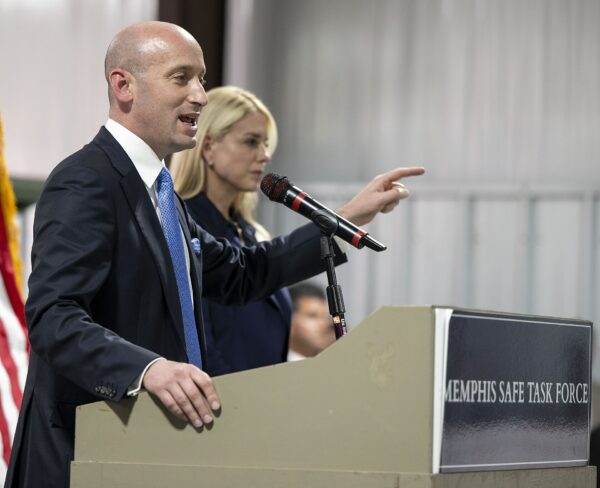
White House Deputy Chief of Staff Stephen Miller faced sharp criticism from some conservatives this week after offering a definition of “America First” during a Fox News appearance that critics say departs from the slogan’s traditional meaning.
The debate unfolded during an interview Wednesday night on Fox News when host Sean Hannity asked Miller to address what he described as confusion about the Trump administration’s foreign policy doctrine.
“I don’t think that people understand the Trump doctrine is not isolationism,” Hannity told Miller. “Maybe you can help set them straight.”
Miller responded by outlining what he said the administration believes “America First” represents, emphasizing the use of U.S. power to defend national interests and respond to threats.
“The president has made clear that he believes America’s awesome military might should be used to protect and defend America’s interests,” Miller said. “Not to surrender the world to our adversaries, to our enemies, to those who would do us harm.”
He continued by describing a vision of the United States maintaining overwhelming global power.
“Not to surrender the world’s resources, lanes of commerce, or capacity to keep our citizens safe,” Miller said. “No, America First means America will be the greatest, most unquestioned, unmatched power in the world, and it means we will defend American lives, and yes, we will avenge American blood.”
Miller also referenced Iran in his remarks, arguing that the country’s leadership has been hostile toward the United States for decades.
“Iran has waged war against the American people, this regime, for 47 years,” he said.
The comments quickly drew criticism from some voices on the right, who argued that Miller’s description strayed from what they see as the historical meaning of the phrase.
Andrew Day, senior editor at The American Conservative, responded on social media by rejecting Miller’s definition.
“That’s not what America First means,” Day wrote. “America First means that the U.S. government, which derives its power and legitimacy from the American people, should advance their interests.”
Other conservative commentators also weighed in on the controversy.
“Turns out ‘America First’ can mean whatever you want it to mean,” wrote commentator Matt Lewis in response to Miller’s remarks.
The debate reflects a broader disagreement over the historical roots and interpretation of the slogan.
For more than a century, the phrase “America First” has often been associated with isolationist or anti-interventionist political movements.
President Woodrow Wilson used the slogan as part of his effort to keep the United States out of World War I. Decades later, the America First Committee adopted the phrase while advocating against U.S. involvement in World War II.
In more recent decades, the slogan was revived by paleoconservative commentator Pat Buchanan during his 2000 presidential campaign, where it was again tied to a non-interventionist approach to foreign policy.
Donald Trump later brought the phrase back into the national spotlight during his 2016 presidential campaign, making “America First” a defining theme of his political message.
In the years since, however, Trump has suggested that the meaning of the phrase ultimately rests with him.
Responding to criticism last year that his administration had strayed from its “America First” commitments, Trump argued that he has the authority to define the slogan.
“Considering that I’m the one that developed ‘America First,’ and considering that the term wasn’t used until I came along, I think I’m the one that decides that,” Trump said.
The president made similar remarks this week while defending his decision to enter Israel’s war with Iran, again asserting his role in defining the meaning of “America First.”
The debate highlights ongoing divisions among conservatives over how the slogan should shape U.S. foreign policy and America’s role on the global stage.
[READ MORE: MAGA Supporters Back Action In Iran]