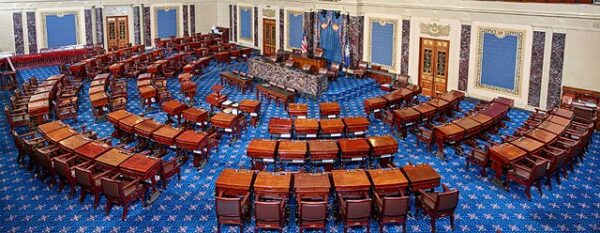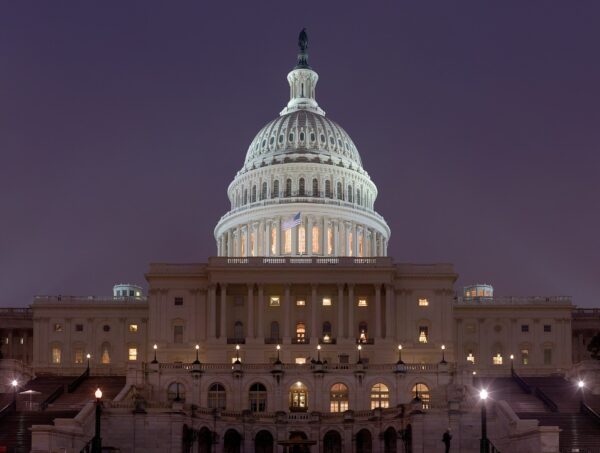
With a federal government shutdown potentially set to begin Friday, partisan divisions in Washington are hardening, and immigration policy has once again become a central flashpoint. Democrats and Republicans are increasingly at odds over how — or whether — to move forward on funding the Department of Homeland Security as part of a broader effort to keep the government open.
Democrats have insisted that the DHS funding bill be separated from the remaining spending legislation, a demand that has complicated negotiations as the deadline approaches. Senate Minority Leader Chuck Schumer laid out a list of immigration-related conditions Wednesday during a Capitol Hill press conference, making clear that Democrats are pressing for changes they say are necessary before agreeing to fund DHS.
Among Schumer’s demands are an end to what he described as “anonymous” immigration enforcement, a prohibition on masked agents, limits on so-called “roving patrols,” and new accountability measures such as body cameras and clearer identification of authorities. Framing the proposals as reforms, Schumer claimed that Democrats are unified behind the effort.
“No more anonymous agents. No more secret operatives,” Schumer said, arguing that his party’s demands reflect what Americans expect from law enforcement. He called the proposals “common-sense reforms” while signaling that Democrats are prepared to pass other bipartisan spending bills — just not the DHS package in its current form.
Schumer said Democrats stand ready to approve five bipartisan bills already before the Senate but insisted that the DHS funding measure “needs serious work.” Fox News reported that some Democrats were invited to the White House to discuss ways to avoid a shutdown but declined to attend.
The standoff has been further inflamed by statements from individual lawmakers. Sen. Ruben Gallego of Arizona said in a post on X that he would not support DHS funding unless key Trump adviser Stephen Miller is fired from the White House. His position reflects growing pressure from Democrats and a small number of Trump-critical Republicans who have called for leadership changes following the Alex Pretti shooting in Minneapolis during Homeland Security’s Operation Metro Surge. Sens. Lisa Murkowski of Alaska and Thom Tillis of North Carolina have been among those voicing concerns.
On the Republican side, there appears to be some openness to separating DHS funding from the broader spending package, though no clear consensus has emerged. Sen. John Kennedy of Louisiana said there is GOP support for the idea, according to The Hill.
Senate Majority Leader John Thune of South Dakota, however, cautioned that much of the talk about splitting up the spending bills remains speculative. He said discussions about isolating DHS funding are “all hypotheticals at this point,” while adding that he wants to keep his options open.
Thune reiterated that his preferred path forward is to keep the spending package intact, warning that sending legislation back to the House — which is out of session this week — could create further uncertainty. He said his goal is to pass all six spending bills in the Senate without having to restart the process.
Earlier this week, Senate Republican Conference Chair Tom Cotton pushed back against what he described as a potential “mob veto” by Democrats, as the administration has warned that a lapse in funding would negatively impact agencies such as FEMA and the TSA. Much of the funding tied to the president’s immigration priorities was already enacted in July through the One Big Beautiful Bill Act.
If a shutdown occurs, it would mark the second in just three months. Some lawmakers are still pointing to the fallout from the nation’s longest shutdown, a 43-day standoff in the fall centered on Affordable Care Act subsidies — an issue that remains unresolved.