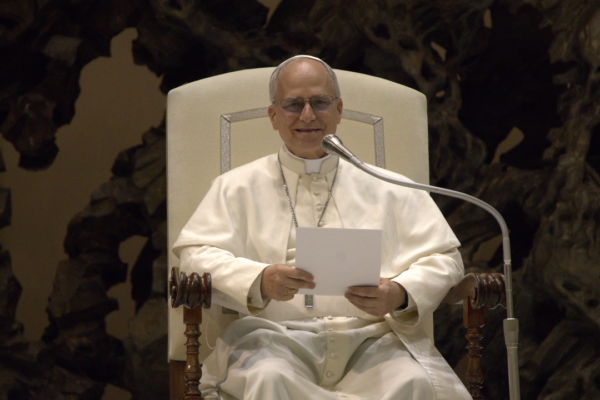
Pope Leo XIV delivered a forceful message against war last week, telling a gathering of cardinals that “war is never blessed by God,” as debate continues over the U.S. and Israeli strikes in Iran and the Trump administration’s defense of the military campaign.
The remarks mark the latest instance of the first American pope speaking out against armed conflict. They also come as President Donald Trump has continued criticizing Leo over the pontiff’s outspoken opposition to several wars, including Russia’s invasion of Ukraine and, more recently, the U.S. and Israeli military action in Iran.
Before becoming pope, then-Cardinal Robert Francis Prevost publicly objected to the Trump administration’s immigration policies, criticized Vice President JD Vance’s comments regarding the theological concept of ordo amoris, and declined Trump’s invitation to serve on his newly formed “Board of Peace.”
According to the report, Leo’s criticism of war has become more pointed during the conflict involving Iran. In March, he urged Christian political leaders who initiate wars to examine their “conscience” and “go to confession.” He followed those remarks in April with several social media posts calling for peace and urging the world to “reject the logic of violence and war.”
The pope returned to the subject during a gathering of cardinals at the Vatican last week. In a Friday homily reported by Vatican News, Leo addressed a range of issues, though the Vatican’s official news outlet highlighted his comments on war with the headline, “Pope at Consistory Opening Mass: War is never blessed by God.”
According to Vatican News, Leo called on the cardinals to seek “the gift of peace in unity” before reflecting on the conflicts affecting people around the world.
“War is never worthy of humanity, and it is never blessed by God,” the pope said, adding that although humanity possesses advanced weapons, “the Creator has endowed us with intelligence and free will to resolve conflicts as human beings and not as beasts.”
Leo also described peace as “a duty of justice because we are one human family,” referring to what he called a “magnifica humanitas” that finds “its head and redeemer in Christ.”
Recalling the teachings of Saint Paul VI and themes from his first encyclical, the pope encouraged continued efforts to build what he called a “civilization of love,” where justice and charity remain inseparable.
“As she proclaims the Gospel, amid both joys and persecutions, the Church is never partial, since she is for everyone, and to each she addresses the same message of conversion and salvation,” Leo said.
Christopher Hale, who writes about the pope in his Letters from Leo Substack, argued that the timing and substance of Leo’s remarks carried broader implications. Hale wrote that the homily “signaled the Vatican may rewrite the just war doctrine itself,” which he said Republicans including Vice President JD Vance and House Speaker Mike Johnson had invoked in defense of the strikes against Iran.
Hale noted that Leo’s comments came as “the United States was bombing Iran for the second straight day,” while writing that a week-old ceasefire had already broken down. He also said Vatican officials have indicated that Leo intends to formally revisit the Church’s just war theory.
Hale pointed to Leo’s May encyclical, Magnifica Humanitas, in which the pope wrote that the just war doctrine is “now outdated” and has “all too often been used to justify any kind of war.”
In the encyclical, Leo wrote that humanity possesses “far more effective and capable tools” for resolving conflicts, including “dialogue, diplomacy and forgiveness,” while stating that “the use of force, violence and weapons reflects a relational poverty that always has disastrous consequences for civilian populations.”
Hale also contrasted Leo’s position with recent remarks from Vance and Johnson defending the Iran strikes in theological terms. Vance cited what he called a “more than 1,000-year tradition of just war theory” at a Turning Point USA event, while Johnson praised Trump and Vance for what he described as their “deep understanding” of the stakes. Hale argued that Leo’s teaching challenges those arguments, writing that a doctrine intended to restrain war “cannot be turned into the instrument that excuses it.”
[READ MORE: Trump Presses Gas Retailers to Lower Prices as Oil Falls]