Questions about the United States’ role in the war with Iran surfaced again Tuesday as a pro-Trump journalist pressed Defense Secretary Pete Hegseth on concerns among some of the president’s supporters that Israel may be benefiting from America’s involvement in the conflict.
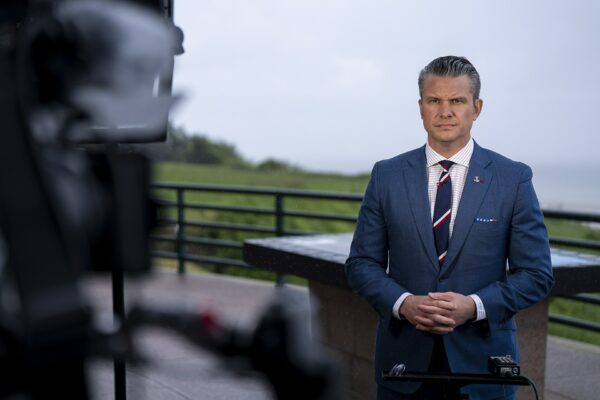
The exchange took place during a Pentagon press conference where Hegseth appeared alongside Chairman of the Joint Chiefs of Staff Gen. Dan Caine. The briefing came as the war with Iran entered its tenth day, with military operations continuing to dominate global headlines.
Jordan Conradson, a correspondent for the pro-Trump outlet Gateway Pundit, raised the issue during the question-and-answer portion of the briefing. Conradson referenced reports about Israeli military activity and asked Hegseth to address concerns circulating among supporters of President Donald Trump.
Citing reporting from Axios that referenced U.S. and Israeli sources, Conradson noted claims that the United States had been unhappy with Israeli strikes targeting Iranian fuel depots.
According to the report referenced by Conradson, Israeli forces struck roughly 30 fuel depots in Iran. Conradson pointed out that President Trump had previously suggested there were certain targets related to energy infrastructure that the United States preferred not to strike because of the long time it would take to rebuild them.
Conradson acknowledged that the report relied on anonymous sources but said the claims appeared consistent with comments Trump had made publicly.
He then asked Hegseth to address concerns from Americans, including supporters of the president, who are uneasy about the war and worry that Israel might be “taking advantage” of U.S. support.
Hegseth responded by emphasizing Israel’s role as an ally while also stressing that the United States is pursuing its own objectives in the conflict.
“I would just state by saying Israel has been a really strong partner in this effort,” Hegseth said.
He acknowledged that the two countries may have different priorities at times but said the United States remains focused on its own mission.
“Where they have different objectives, they’ve pursued them. Ultimately, we’ve stayed focused on ours,” he said.
Hegseth also noted that Iran has felt the combined military strength of both countries.
“What Iran has felt is the power of the world’s two most powerful air forces,” he said, adding that certain strikes referenced by Conradson were not conducted by the United States or tied directly to U.S. objectives.
Addressing concerns about the United States being pulled deeper into the conflict, Hegseth said President Trump remains firmly in control of the strategy.
“The president has made it clear to those concerns that we’re not getting pulled in any direction. We’re leading,” Hegseth said.
He added that Trump is determining the direction and outcome of the operation with what he described as a careful and focused approach.
Hegseth also said he understands why many Americans remain wary of becoming entangled in another prolonged war.
“I understand those concerns because I’ve heard from a lot of people who went through — I went through 20 years of those wars myself — worried about getting dragged in, worried about mission creep, worried about nation building or democracy expansion,” he said.
According to Hegseth, those fears reflect the lessons learned from decades of overseas conflict. He argued that previous administrations sometimes committed resources and personnel without a clearly defined end state.
“Just because previous presidents and previous secretaries have decided to just pour more resources and more people in toward some unguided end state doesn’t mean that’s the way the world needs to look today,” he said.
Hegseth emphasized that the administration believes the American public voted for a different approach to foreign policy.
At the same time, he said the president has been clear about one central objective.
“The president also stated from the beginning that Iran can’t have a nuclear weapon,” Hegseth said.
He argued that while many leaders have voiced similar concerns in the past, acting on them requires determination.
“Anybody can say that,” he said, referencing past statements by former President Barack Obama.
Still, Hegseth stressed that even with that determination, the administration aims to keep the mission limited and clearly defined.
“That sacrifice of Americans, American treasure, American lives — all of those properly meet the objective that you’re trying to accomplish,” he said.
For Hegseth, that balance remains central as the war continues.
“My job is to keep it scoped,” he said, explaining that his role is to carry out the president’s directive while ensuring the mission remains focused.