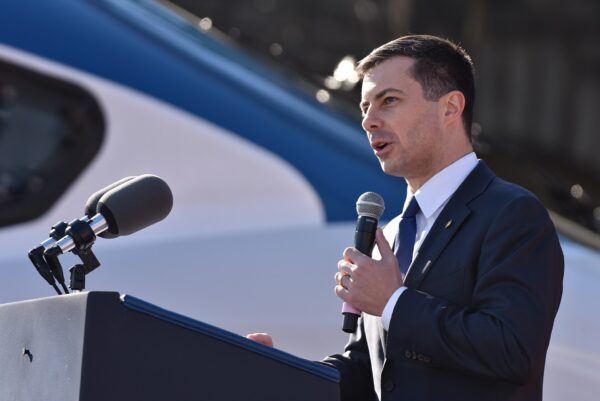
A new poll circulating widely on social media shows former Transportation Secretary Pete Buttigieg performing shockingly poorly among black voters—so poorly, in fact, that he trails the level of support former Ku Klux Klan leader David Duke received in 2016. The Fall 2025 Yale Youth Poll found that just 4 percent of black voters would back Buttigieg if the 2028 Democratic presidential primary were held today.
Online observers were quick to highlight the comparison: Duke, when running for Senate in Louisiana in 2016, drew support from 14 percent of black voters—more than three times Buttigieg’s number. While the poll does not suggest black voters favor Duke today, the historical comparison underscores how deep Buttigieg’s challenges are with this key Democratic constituency.
According to the Yale poll, Buttigieg is one of the least popular 2028 prospects among black Democrats, though not the very last. He still outpaced Pennsylvania Gov. Josh Shapiro, who registered at 0 percent, and former Democratic vice presidential nominee Tim Walz, who earned 1 percent.
Blacks supported the Grand Wizard of the KKK over 3x more than they do Pete Buttigieg. https://t.co/kO9DQofE7W pic.twitter.com/YmXsCuStxS
— Magills (@magills_) December 9, 2025
Former Vice President Kamala Harris dominated among black Democrats with 47 percent support, reinforcing her longstanding strength with that voting bloc. She was followed distantly by California Gov. Gavin Newsom at 12 percent and Rep. Alexandria Ocasio-Cortez at 9 percent.
But the poll also shows fractures within the Democratic coalition. White, Hispanic, and Asian Democrats all preferred Newsom over Harris, indicating a potential internal split as the party looks toward 2028. Among white Democrats, Buttigieg emerged as the second-most popular choice, even as his numbers cratered with black voters. He performed strongest with elderly Democrats, garnering 18 percent support among voters ages 65 and up.
Meanwhile, Republicans appear far more unified heading into the next presidential contest. Vice President JD Vance dominated the GOP field with a commanding 51 percent support—numbers any candidate would envy this far out from an election. Vance’s standing reflects the deep loyalty he enjoys within the party base and the growing belief among conservatives that he represents the future direction of the Republican Party.
Vance was followed distantly by Donald Trump Jr. at 8 percent, Florida Gov. Ron DeSantis at 6 percent, former U.N. Ambassador Nikki Haley at 5 percent, Secretary of State Marco Rubio also at 5 percent, and both Secretary of Health Robert F. Kennedy Jr. and former Fox News host Tucker Carlson at 3 percent apiece.
Notably, Carlson placed second among the youngest Republican voters—those ages 18 to 22—trailing only Vance. The result suggests that while Vance enjoys broad multi-generational appeal, Carlson continues to hold a unique influence among young conservatives.
The contrast between the parties is stark. Republicans appear to have a frontrunner consolidating support early, while Democrats face internal divisions and a major vulnerability in Buttigieg—whose numbers with black voters remain an unmistakable warning sign for a party that has long depended on their backing to win national elections.
[READ MORE: Trump To Begin Interviews For Fed Chairman]