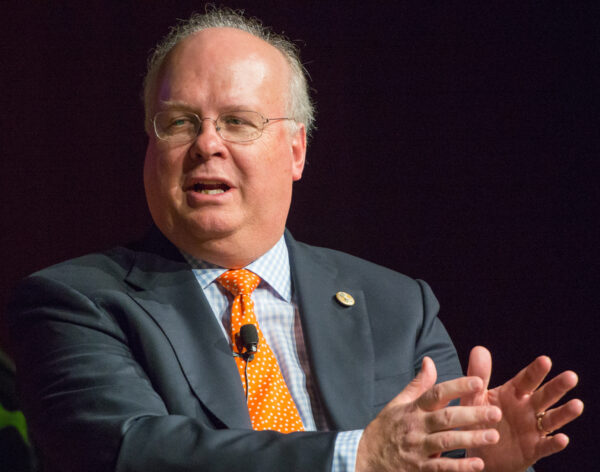
Veteran Republican strategist Karl Rove suggested over the weekend that Iran could attempt to influence this fall’s midterm elections by creating instability that impacts oil prices, arguing the regime understands the political stakes facing President Donald Trump.
Speaking during a Fox News appearance with anchor Paul Gigot, Rove discussed the political challenges surrounding the administration’s handling of the conflict with Iran. Gigot noted that Trump still faces the task of convincing the public that the U.S. military campaign has been successful.
Rove pointed to upcoming polling from the Reagan Institute, saying respondents were asked what outcome they preferred regarding Iran. According to Rove, participants were presented with three broad options, including pursuing negotiations that would leave Iran’s current government in place in exchange for limits on its nuclear and missile programs, as well as alternatives involving varying degrees of regime change.
Rove said the polling showed a sharp divide among political groups. He noted that Democrats favored negotiations over regime change by a margin of 52% to 39%. Republicans, however, were much more supportive of replacing or weakening the current Iranian government, with only 25% favoring negotiations while 69% supported some form of change. He added that self-identified MAGA Republicans held nearly identical views, with roughly 25% backing negotiations and 70% favoring regime change.
Perhaps most significant, Rove said, were the responses from independent voters, whom he described as likely to play a decisive role in this year’s elections. According to the poll numbers he cited, just 17% of independents supported negotiations while 71% favored changing Iran’s government.
Rove argued those results help explain why the president has received criticism over the outcome of the conflict. In his view, Trump’s current approach has disappointed many of his own supporters without significantly winning over political opponents. While Democrats generally preferred negotiations, Rove said Republicans and independents were more inclined to favor changes to Iran’s leadership.
Gigot then turned the conversation toward the economy, noting that Trump has highlighted declining oil prices and lower gasoline costs as signs that conditions are improving. He suggested the president may believe that lower fuel prices could ease inflation concerns and create a stronger economic environment heading into the midterm elections, potentially offsetting public doubts about the outcome of the Iran conflict.
Rove acknowledged that lower gas prices would likely benefit the president politically but cautioned against assuming they would determine the election outcome on their own.
Even if lower fuel prices provide some political advantage, Rove argued there are other factors to consider. He warned that Iran is closely monitoring both economic conditions and the U.S. political calendar.
According to Rove, negotiations with Iran are expected to conclude by the middle of August, just before the fall campaign season begins in earnest after Labor Day. Because of that timing, he said he would not be surprised if Iranian leaders attempted to influence events by creating new problems in mid-August.
Such actions, Rove suggested, could drive oil prices higher and increase uncertainty at a politically sensitive moment as the midterm election campaign intensifies.
[READ MORE: Interior Secretary Burgum Highlights National Parks Before Pointing to Lower Gas Prices in Red States]