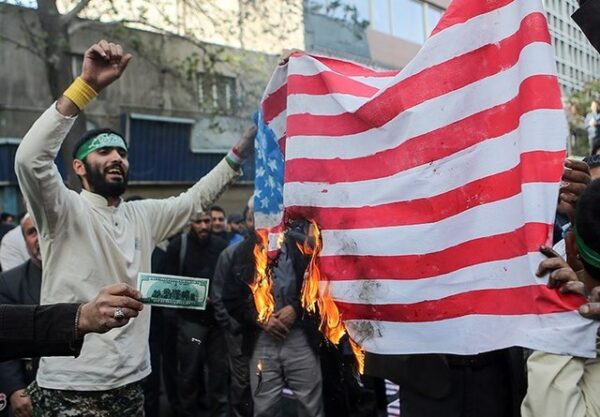
Iran has now reportedly issued stark warnings to neighboring countries hosting U.S. troops, threatening to strike American military bases if Washington intervenes in the country amid a brutal crackdown on protesters, according to a senior Iranian official who spoke to Reuters on Wednesday.
The warning comes as President Donald Trump continues to publicly signal his readiness to act in response to violence against protesters in Iran, where unrest has erupted into one of the largest challenges to clerical rule in decades. A rights group has said as many as 2,600 people have been killed during the crackdown, underscoring the scale of the bloodshed.
According to the Iranian official, Tehran has informed regional governments that any U.S. strike on Iran would trigger retaliation against American bases located in their countries. That message was reportedly delivered to U.S. allies including Saudi Arabia, the United Arab Emirates, and Turkey, as Iran seeks to deter what it sees as growing threats from Washington.
Three diplomats told Reuters that, against this backdrop, some U.S. personnel had been advised to leave the Al Udeid Air Base in Qatar by Wednesday evening. The base serves as a critical hub for U.S. military operations in the region. One diplomat characterized the move as a “posture change,” not an ordered evacuation, noting there were no signs of a mass withdrawal like the one that preceded Iran’s missile strike on the base last year.
At that time, troops were temporarily relocated to nearby civilian facilities before Iran launched missiles in retaliation for U.S. airstrikes on Iranian nuclear targets. This time, diplomats said, there was no comparable movement of forces to nearby stadiums or shopping centers, suggesting a more limited adjustment rather than an imminent escalation.
The U.S. embassy in Doha declined to comment, and Qatar’s foreign ministry did not immediately respond to requests for comment. The United States maintains a significant military footprint across the Middle East, including the forward headquarters of U.S. Central Command at Al Udeid and the U.S. Navy’s Fifth Fleet headquarters in Bahrain.
Iranian authorities have blamed the unrest on foreign interference, accusing the United States and Israel of fomenting the protests and labeling demonstrators as terrorists. Tehran has also reportedly suspended direct contacts between Foreign Minister Abbas Araqchi and U.S. Special Envoy Steve Witkoff, signaling a further freeze in already strained diplomacy.
Trump has been openly discussing possible U.S. action for days, though he has not detailed the scope or timing. In an interview with CBS News on Tuesday, he warned of “very strong action” if Iran continues executing protesters. He also used social media to urge Iranians to keep protesting and take over institutions, declaring that “help is on the way.”
An Israeli official told Reuters that, according to Israel’s assessment, Trump has decided to intervene, though how and when remains unclear.
Meanwhile, information from inside Iran has been severely limited by an internet blackout. The U.S.-based HRANA rights group said it has verified the deaths of 2,403 protesters and 147 government-affiliated individuals, while an Iranian official separately told Reuters that about 2,000 people had been killed.
French Foreign Minister Jean-Noel Barrot described the crackdown as potentially the most violent repression in Iran’s contemporary history and said it must stop. A Western official cautioned, however, that the Iranian government does not appear to be on the brink of collapse, noting that its security apparatus remains in control and has restored some measure of calm, even after being caught off guard by the unprecedented scale of the unrest.