Iran has put forward a new proposal to reopen the Strait of Hormuz, following a heated exchange between President Donald Trump and Iran’s president in their dueling speeches at the United Nations General Assembly this week.
Iranian Foreign Minister Abbas Araghchi laid out the plan Thursday during what was described as a “private gathering” on the sidelines of the General Assembly, according to the Associated Press.
Under the proposal, Iran would agree to a reopening of the strait and a resumption of nuclear talks in seven days. In exchange, the U.S. would have to end its naval blockade in the strategic waterway, drop sanctions and agree to a ceasefire.
Trita Parsi, executive vice president of the Quincy Institute think tank, attended the meeting. He told the AP that the deal could hand Trump a much-needed boost as the ongoing war pushes up the price of gas and other goods.
“If Trump calculates this arrangement is worthwhile and can bring political benefit before the midterms and reduce gas prices, perhaps we’ll see flexibility not seen in previous weeks,” Parsi said.
But negotiators may recognize the terms. As the AP pointed out, the proposal closely resembles the so-called Memorandum of Understanding reached in June, only on a faster timeline. That earlier agreement had called for a 60-day interim period, but it quickly fell apart after Iran resumed attacks on shipping in the strait.
The new offer comes on the heels of a dramatic war of words at the UN.
During his address to the General Assembly on Wednesday, Trump raised the possibility of “annihilating” the Islamic regime, laying out two starkly different paths for Tehran.
“Will a deal be made with Iran that lets them rebuild and create a far greater country than it ever was before — maybe one of the greatest in the Middle East, or even the world? Or do I annihilate the Islamic Republic, and do it quickly, never giving them a chance to kill and destroy people and countries again? Do I drive them into hell, with no chance of survival and no hope of future greatness for generations?” Trump said.
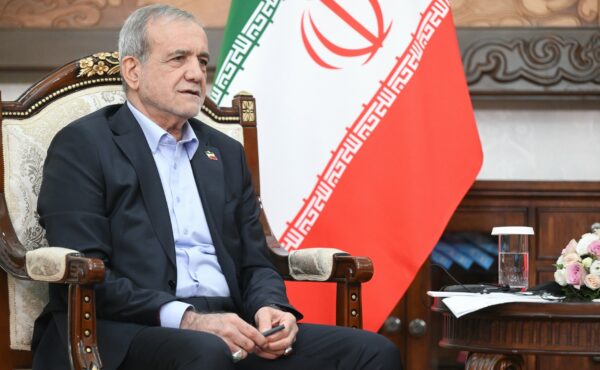
Iran fired back the next day. Iranian President Masoud Pezeshkian warned Trump that Tehran would not bow to “bullying,” declaring that the regime’s “resistance” would only grow stronger.
The back-and-forth highlights the high stakes surrounding the Strait of Hormuz, a strategic waterway at the center of the conflict. The U.S. naval blockade there is one of the key issues Iran wants resolved as part of any agreement.
The largely unpopular war began on Feb. 28 with joint U.S. and Israeli strikes on Iran. The conflict is now about to enter its eighth month.
Whether the White House takes Iran up on its offer remains to be seen. With the June agreement having collapsed after Iran resumed attacks on shipping, the new proposal’s similarity to that deal may give negotiators pause. Still, as Parsi suggested, rising gas prices and the approaching midterms could factor into how the president weighs the arrangement.
[READ MORE: CNN’s Scott Jennings calls Trump’s state dinner press ban “a miss” after network blocked from Xi event]