A tense exchange on Capitol Hill is shedding new light on the justification for President Donald Trump’s decision to go to war with Iran, raising questions not only about intelligence assessments, but also about how such determinations are ultimately made.
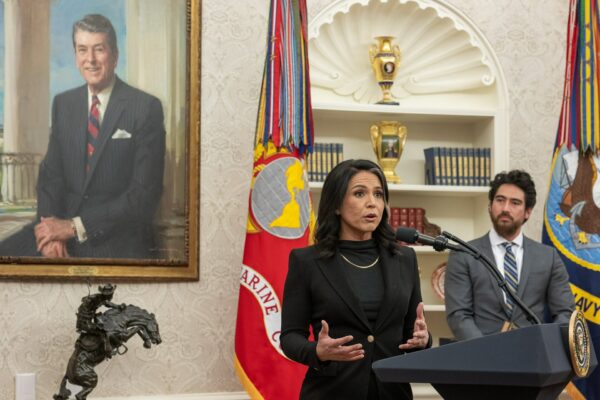
During a Senate Intelligence Committee hearing on worldwide threats, Senator Jon Ossoff (D-GA) pressed Director of National Intelligence Tulsi Gabbard on whether the intelligence community actually assessed that Iran posed an “imminent nuclear threat” — the central claim cited by the White House in launching military action.
The administration has consistently maintained that the conflict was initiated to eliminate what it described as an imminent danger from Iran’s nuclear ambitions. Gabbard echoed that language in a statement following the resignation of Joe Kent, asserting that the president acted after determining such a threat existed.
But under questioning, Gabbard acknowledged key intelligence findings that complicate that narrative.
She confirmed that the intelligence community assessed Iran’s nuclear enrichment program had been “obliterated” by prior U.S. airstrikes and further testified that there had been “no effort” by Iran to rebuild that capability since. Those admissions appeared to bolster Ossoff’s line of questioning, as he sought a direct answer on whether the intelligence itself supported the claim of an imminent threat.
Ossoff repeatedly asked a straightforward question: Did the intelligence community determine that Iran posed an imminent nuclear threat at the time the war was launched?
Gabbard did not provide a direct yes-or-no answer.
Instead, she argued that determining what qualifies as an “imminent threat” is not the responsibility of the intelligence community, but rather the president. According to Gabbard, the intelligence community provides information and assessments, while the final judgment rests with the commander in chief.
“The only person who can determine what is and is not an imminent threat is the president,” she said.
That response drew sharp pushback from Ossoff, who argued that assessing threats is precisely the role of the intelligence community — especially in a hearing specifically focused on global dangers. He accused Gabbard of sidestepping the question to avoid contradicting the administration’s public justification for the war.
“You won’t answer the question,” Ossoff said, after multiple attempts to get a direct response.
Gabbard maintained that she was fulfilling her role by presenting intelligence inputs, while reiterating that the president ultimately weighs those inputs to make decisions.
The exchange highlights a broader tension that has long existed in Washington: the line between intelligence assessments and policy decisions. While the administration insists its actions were necessary to protect American interests and prevent future threats, the hearing underscored lingering uncertainty about how those threats are defined and communicated.
Even as officials defend the decision to act, the discussion reflects a deeper unease that often accompanies military engagements — particularly in the Middle East, where past conflicts have carried significant and lasting costs.
At its core, the clash between Ossoff and Gabbard reveals more than a disagreement over wording. It points to an ongoing debate about accountability, transparency, and the weight of decisions that can send American forces into harm’s way.
As the administration continues to stand by its actions, questions remain about the intelligence behind them — and whether the threshold for war was clearly, and convincingly, met.
[READ MORE: GOP Lawmaker Warns of Party “Implosion” if Trump Moves to Break from NATO]