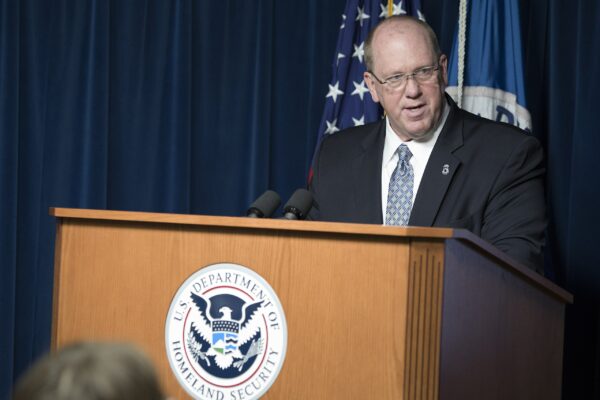
Trump administration border czar Tom Homan announced a major reduction in federal law enforcement personnel in Minneapolis on Wednesday, citing what he described as “unprecedented cooperation” from local and state officials that has improved both public safety and the efficiency of immigration enforcement.
Speaking at a morning press conference, Homan said the drawdown follows significant progress made in coordination with local authorities, allowing Immigration and Customs Enforcement to carry out its mission with fewer officers deployed on the streets. He framed the move not as a retreat from enforcement, but as the result of smarter, safer policing.
Homan was tasked with overseeing the administration’s immigration enforcement efforts in Minnesota following the fatal shootings of Renee Good and Alex Pretti during separate altercations involving ICE and Border Patrol personnel. Those incidents sparked heightened scrutiny of federal enforcement operations in the state and intensified pressure for changes in how those operations were conducted.
Last week, Homan struck a noticeably more optimistic tone when discussing cooperation with Minnesota Gov. Tim Walz and Minneapolis Mayor Jacob Frey, both Democrats. At that time, he acknowledged that mistakes had been made and emphasized the importance of working more closely with local officials. On Wednesday, he said that cooperation has already paid dividends.
According to Homan, an increasing number of counties are now communicating with ICE and allowing federal agents to take custody of illegal aliens directly from local jails before their release. He described this level of collaboration as unprecedented and said it dramatically reduces the need for large-scale street operations.
“This is efficient,” Homan said, explaining that transferring custody in jails often requires only one or two officers, rather than eight or ten officers conducting arrests in the community. That approach, he said, frees up personnel to focus on arresting or removing criminal aliens and reduces the number of officers involved in potentially dangerous street encounters.
Homan stressed that the coordination benefits everyone involved. He said fewer officers on the streets conducting operations means safer conditions for communities, law enforcement, and the individuals being taken into custody. He also emphasized that the arrangement makes the Twin Cities safer overall.
He was careful to note what local officials are not being asked to do. Homan said jails are not required to hold anyone beyond their normal release time for immigration purposes. He also emphasized that state and local officials are not being asked to act as immigration officers or engage in immigration enforcement themselves. Their role, he said, is limited to notifying ICE prior to a release, without extending detention by even a minute.
Because of the increased cooperation and the reduced need for large enforcement teams, Homan announced that the administration is immediately drawing down 700 law enforcement personnel connected to these operations. He said the reduction reflects a safer and more efficient enforcement environment, not a scaling back of the law.
Homan also reiterated that ICE will continue to conduct targeted immigration enforcement operations, consistent with how the agency has operated for decades. Those efforts, he said, will be based on reasonable suspicion and focused on national security threats, public safety risks, and transnational criminal organizations.
While emphasizing public safety priorities, Homan made clear that immigration enforcement more broadly will continue. Prioritizing the most serious threats, he said, does not mean abandoning enforcement of the nation’s immigration laws.