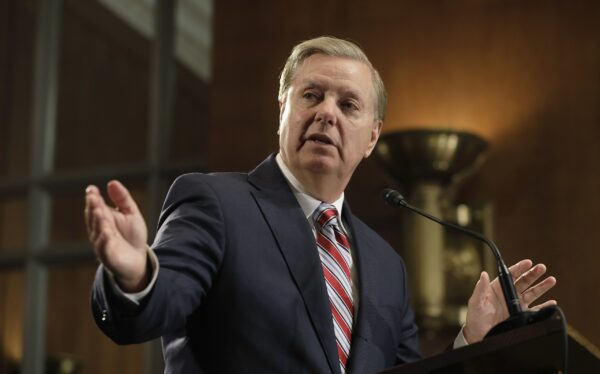
A Republican challenger in South Carolina’s upcoming Senate race is reportedly taking aim at longtime incumbent Lindsey Graham with a striking claim tied to an international controversy that continues to stir debate years later.
Mark Lynch, who is seeking the GOP nomination to replace Graham in 2026, argued over the weekend that the senator bears responsibility for the 2020 decision to convert the historic Hagia Sophia from a museum back into a mosque. Lynch made his case in a social media post, accusing Graham of remaining silent during what he described as a major turning point for a site he views as central to Christian history.
In his remarks, Lynch called the conversion “one of the greatest injustices in Christian history” and pledged that, if elected, he would pursue aggressive measures to pressure Turkey into reversing the decision. Among those measures, he proposed introducing legislation to ban all imports from Turkey—totaling more than $17 billion annually—until ownership of Hagia Sophia is transferred to the Greek Orthodox Church.
Lynch also outlined plans to rally religious leaders in Washington, saying he would invite Christian clergy from multiple denominations to the U.S. Capitol to advocate for passage of what he calls the “Return the Hagia Sophia to the Church Act.” He further vowed to oppose what he described as the takeover of Christian churches by Islam, both abroad and within the United States.
The claims, however, come amid broader context surrounding the status of Hagia Sophia. While Lynch attributed the 2020 change to international actors, a proposed Community Note on his post points out that the building was first converted into a mosque in 1453 and later served as a museum from 1935 until 2020. The same note emphasizes that the decision to revert it to a mosque was made by the Turkish government, not by the United Nations.
In fact, the UNESCO publicly opposed the move at the time. Director-General Audrey Azoulay expressed regret that Turkish authorities acted without prior discussion and raised concerns about the impact on the site’s status as part of Istanbul’s World Heritage listing.
UNESCO described Hagia Sophia as an architectural masterpiece and a symbol of cultural dialogue, noting that its designation as a museum had reflected its universal significance. The organization also stressed that member states have an obligation to notify and consult before making changes that could affect the value of protected heritage sites.
Despite those objections, the Turkish government proceeded with the change, drawing international criticism and reigniting long-standing tensions over the building’s identity and historical role.
Lynch’s campaign comments reflect a broader frustration among some conservatives over perceived inaction by U.S. leaders on cultural and religious issues abroad. At the same time, his proposed response—leveraging economic pressure through sweeping import bans—highlights the growing intersection between foreign policy and domestic politics.
Such proposals also underscore the difficult balance policymakers face when responding to international disputes. Efforts to assert influence overseas can carry significant economic and diplomatic consequences at home, raising questions about how far the United States should go in confronting decisions made by other nations.
As the South Carolina race begins to take shape, Lynch’s remarks signal that even global cultural controversies may find their way into the heart of domestic political battles, where rhetoric can be sharp and solutions far from simple.