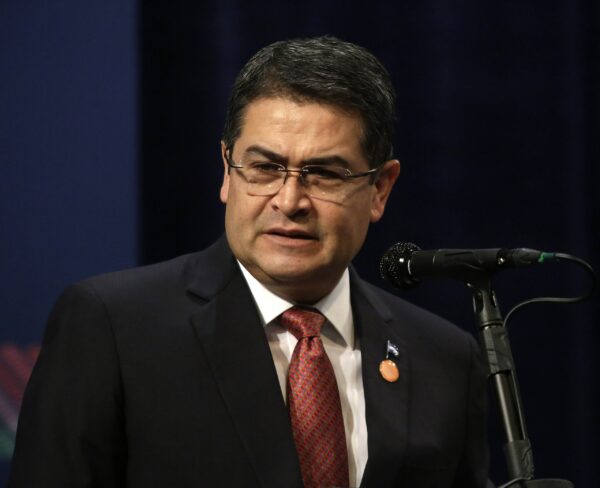
Former Honduran President Juan Orlando Hernández was reportedly released from U.S. federal prison Monday after President Donald Trump granted him a full pardon, wiping away a 45-year sentence tied to drug-trafficking charges. Hernández, once a key U.S. ally in Central America, had been convicted last year of helping traffickers move cocaine into the United States — a prosecution Trump says was politically tainted.
Hernández’s wife, former first lady Ana García Carías, celebrated the news in an emotional statement on X early Tuesday. “After nearly four years of pain, waiting, and difficult trials, my husband Juan Orlando Hernández RETURNED to being a free man, thanks to the presidential pardon granted by President Donald Trump,” she wrote.
“Today we give thanks to God, because He is just and His timing is perfect,” she continued, thanking Trump for “restoring our hope” and insisting her husband had been wrongfully accused. She praised supporters who “never stopped praying” and “defending the truth,” calling the pardon a “miracle.”
Hernández was convicted in March 2024 in a New York federal court for more than a decade of collaboration with traffickers — a case prosecutors said involved at least 400 tons of cocaine headed for the U.S. He was sentenced in July to 45 years in prison. Trump pardoned him Friday, arguing the former leader was “treated very harshly and unfairly.”
Speaking to reporters aboard Air Force One, Trump said he intervened after hearing directly from Hondurans who believed the prosecution was political. “They basically said he was a drug dealer because he was the president of the country,” Trump said. “And they said it was a Biden administration setup. And I looked at the facts and I agreed with them.”
The pardon came just days before Hondurans went to the polls to elect a new president — an election Trump has been watching closely. He endorsed conservative candidate Nasry “Tito” Asfura, saying the U.S. would strongly back Honduras if he wins. “The United States has so much confidence in him, his policies, and what he will do for the Great People of Honduras,” Trump wrote. But he warned that if Asfura loses, the U.S. will “not be throwing good money after bad,” saying a “wrong leader” would bring “catastrophic results.”
Not everyone in Trump’s orbit supported the move. Rep. Maria Elvira Salazar (R-FL), a prominent critic of Latin American corruption, told CNN she “would have not” pardoned Hernández. But she stressed that she still backs Trump’s broader foreign-policy approach — especially his hard-line strategy toward Venezuela over its alleged drug-trafficking operations.
“I do know that right now what the president is doing with Venezuela is exactly correct for many reasons,” Salazar said. “And that’s why I stick to what I’m telling you.”
Still, she reiterated her concern: “We are in an imperfect world, but I would have not taken that action.”
With Hernández now free and political tremors shaking Central America, Trump’s pardon is already reshaping U.S.–Honduras relations — and sending a clear signal about where the administration stands as the region confronts corruption, instability, and rising cartel influence.
[READ MORE: White House Clarifies Second-Strike Controversy, Says Admiral — Not Hegseth — Issued Order on Venezuelan Vessel]