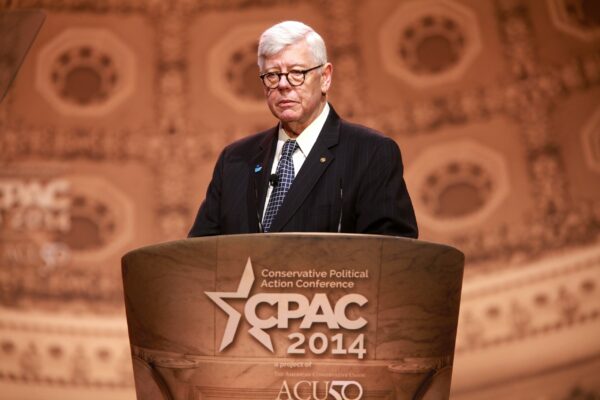
David Keene, a central figure in the rise and maturation of the modern conservative movement who spent decades shaping both grassroots activism and Washington policymaking, passed away Sunday after battling pancreatic cancer. He was 80.
Keene’s career placed him at the heart of conservative politics during a period when the movement transformed from a relatively small intellectual force into a major influence on national policy and elections. Over the years, he helped elevate major conservative institutions, including the Conservative Political Action Conference and the National Rifle Association, while maintaining strong relationships with leaders in government and media.
For many in conservative circles, Keene represented a bridge between activists and those wielding political power. Associates often pointed to his unusual ability to move comfortably between the world of grassroots politics and the halls of Washington without losing credibility with either.
Richard Viguerie, a longtime leader in conservative political organizing, said Keene’s influence came not only from his political skill but from the trust he commanded within the movement.
“He was a true believer,” Viguerie said. “All the conservatives knew he was a true believer, and then people he advised and counseled in the political arena knew he was really, really good at what he did.”
Keene was born in Rockford, Illinois, and raised in Wisconsin. Like many conservatives of his generation, his political outlook evolved during the turbulent early years of modern American politics. He initially volunteered for John F. Kennedy’s presidential campaign in 1960 but later became a supporter of Barry Goldwater in 1964.
Keene later explained that his ideological shift came after a high school librarian gave him a copy of Friedrich Hayek’s The Constitution of Liberty, a book that had a profound impact on his thinking.
After graduating from law school, Keene became national chairman of Young Americans for Freedom and ran for the Wisconsin state Senate. He eventually moved to Washington, where he joined the Nixon administration and worked for Vice President Spiro Agnew.
Looking back on that era in an interview last summer with former Indiana Gov. Mitch Daniels, Keene described a time when the conservative movement had only a minimal presence within the federal government.
He recalled that the White House had established a Committee of Six intended to serve as liaisons to conservative activists.
“They never had six members because we never had six people in the White House,” Keene said.
Over the years, he became a prominent lobbyist and political adviser, counseling members of Congress, presidential candidates and Republican administrations.
Keene also played a major role in building CPAC into the country’s most influential annual gathering for conservative activists and Republican presidential hopefuls. Serving as volunteer chairman of the American Conservative Union from 1984 to 2011, he expanded the conference from a small meeting of several hundred participants into an event drawing roughly 11,000 attendees.
After stepping down from the ACU, Keene became president of the National Rifle Association, serving the organization in a volunteer role for two customary two-year terms.
Later, he moved into journalism, becoming opinion editor at The Washington Times in 2013 before later serving as editor at large.
During his time at the paper, Keene wrote on a wide range of subjects, from presidential authority and criminal justice reform to international affairs. One column celebrated Independence Day by reflecting on President Calvin Coolidge, whom Ronald Reagan admired and honored by placing his portrait in the White House Cabinet Room.
Friends and colleagues frequently remembered Keene for his storytelling and political insight.
Wayne LaPierre, longtime executive vice president of the NRA, said Keene had a talent for sharing memorable political stories while offering sharp observations about the country’s political landscape.
Keene was also known for maintaining friendships across ideological lines. His relationships included journalists from The New York Times and leaders from organizations such as the American Civil Liberties Union and People for the American Way.
“He believed different views deserved a place at the table and should be heard,” LaPierre said.
In later years, Keene also took positions that sometimes challenged conventional partisan divides. While leading the American Conservative Union, he opened CPAC to GOProud, a group of gay conservatives, a move that drew attention at the time.
He also worked alongside Viguerie to advocate for criminal justice reform, criticizing policies such as mandatory minimum sentences, three-strikes laws and the elimination of parole, which he argued contributed to excessive incarceration.
Keene likewise found common ground with the ACLU on certain First Amendment issues, including efforts to push back against aspects of the Patriot Act.
Ian Walters, who worked with Keene at the ACU, said those collaborations reflected Keene’s belief that some causes transcended party lines.
“He believed and understood that, yeah, you do your party politics, but there are these opportunities where the left and right come together, and those are righteous causes,” Walters said.
Former Mississippi Gov. Haley Barbour recalled Keene as a straightforward and generous friend, remembering how Keene once helped him and his wife search for an apartment when Barbour first arrived in Washington.
“What you see is what you get,” Barbour said. “We need more people like him today in both parties and in the news.”
Keene is survived by his wife Donna Wiesner Keene; his brothers James Keene of Wisconsin and Charles Keene of Indiana; and his children Tracy Wilson, Kerry Bankhert, David M. Keene, Taylor Keene and Lisa Keeton, along with their families.
[READ MORE: Explosion Rocks U.S. Embassy Entrance in Oslo as Police Launch Investigation]