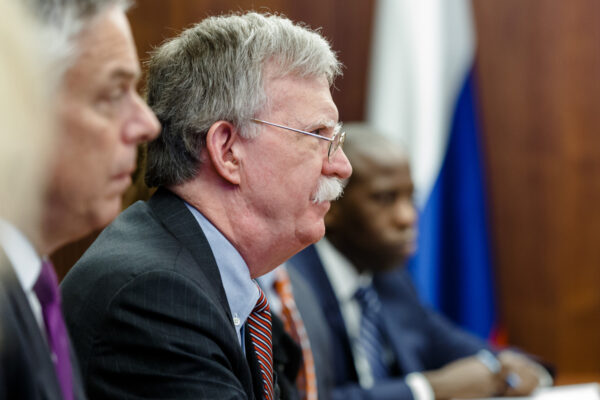
Former U.S. ambassador to the United Nations and one-time national security advisor John Bolton is once again pressing for a more aggressive approach toward Iran, arguing that any lasting peace in the Middle East hinges not on diplomacy, but on regime change in Tehran.
Speaking during an appearance on Piers Morgan Uncensored with host Piers Morgan, Bolton made clear he believes negotiations with the Iranian government are ultimately futile. When asked what it would mean to “finish the job” in dealing with Iran, Bolton admitted uncertainty about President Donald Trump’s exact objectives but quickly pivoted to his own long-standing position.
“There is no route to peace and security in the Middle East on any lasting basis until the regime in Tehran is removed,” Bolton said, framing regime change as the only viable endgame.
Bolton acknowledged that nuclear concerns are at the forefront of the administration’s focus, but argued that even eliminating Iran’s nuclear ambitions would not guarantee stability. In his view, only a government in Tehran that fully renounces such ambitions can provide lasting security.
Morgan pressed Bolton on whether that effectively rules out any negotiated settlement, asking if “finishing the job” means forcing Iran to give up or destroy its enriched uranium under a new regime. Bolton did not waver.
“I wouldn’t do a deal with the regime in Tehran,” he said plainly. “I don’t trust them, and I don’t think that simply doing a deal provides the kind of security we need.”
The conversation then turned to the strategic importance of the Strait of Hormuz, a critical global chokepoint for energy supplies. Morgan pointed out that despite military pressure from the United States and its allies, Iran appears to retain significant leverage by virtue of its geographic position, capable of disrupting global markets in energy and other key commodities.
Bolton agreed that Iran’s ability to influence the strait is a serious concern but argued it is far from a new development. He noted that the vulnerability of the Persian Gulf has long been understood by military planners, describing it as a confined and difficult environment for naval operations.
He also pointed to historical precedent, referencing Iran’s past efforts to disrupt shipping in the late 1980s. During that period, the United States took steps to protect commercial vessels by reflagging and escorting them, underscoring that tensions in the region are not a recent phenomenon.
Bolton suggested that both the risks and Iran’s tactics were foreseeable, adding that Iranian actions against Gulf Arab states were anticipated as part of the broader conflict dynamic.
Still, the exchange highlighted a deeper dilemma. While a hardline approach may appeal to those skeptical of negotiations, it also raises difficult questions about escalation and long-term consequences. Morgan’s line of questioning underscored that if Iran believes its leverage is key to survival, it may have little incentive to negotiate away its advantages.
Bolton’s position leaves little room for compromise, reflecting a belief that only decisive structural change in Iran can resolve the crisis. Yet even as calls for a tougher stance grow louder, the path forward remains uncertain—caught between the limits of diplomacy and the risks of an open-ended confrontation.
[READ MORE: Trump Halts Strait Operation Amid Gulf Pushback as Iran Talks Gain Momentum]