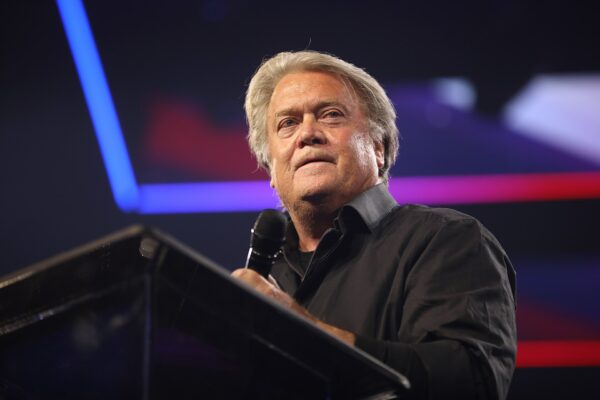
Former Trump White House advisor and longtime MAGA figure Steve Bannon ignited a media firestorm this week after telling listeners of his podcast that Immigration and Customs Enforcement and federal agents should be deployed to polling stations during the 2026 midterm elections.
Bannon’s comments came amid heightened political rhetoric surrounding election oversight, following President Donald Trump’s call for Republicans to “take over” elections and to “nationalize” the voting system—language critics quickly seized on as controversial and contrary to the constitutional framework governing elections.
The remarks drew swift backlash from left-leaning media figures, including MSNBC host Katy Tur, who devoted a segment Wednesday to Bannon’s comments. Tur discussed the issue with Hofstra Law School professor James Sample, framing the comments as part of what they described as a broader pattern of alarming rhetoric tied to Trump and his allies.
Sample argued that while Trump often makes provocative statements, there are always individuals willing to push those ideas further. He suggested that even when Trump’s proposals fail or are rebuffed, they contribute to a cumulative effect. Sample cited recent remarks from House Speaker Mike Johnson, who said he believes elections are rigged against Republicans while acknowledging he has no proof, as part of what Sample described as “bricks in the wall.”
According to Sample, Bannon’s call for ICE presence at polling locations fits into that same pattern, along with references to Tulsi Gabbard traveling to Georgia and what he characterized as ongoing rhetoric about voter fraud. Sample asserted that such rhetoric fuels threats against election officials and undermines confidence in the electoral system.
He went on to argue that talk of nationalizing elections on a partisan basis is not about promoting integrity, but rather about undermining it. Sample claimed that calls for Republicans to take over election administration in certain states amount to an unconstitutional effort to reshape the system for political advantage.
Tur then introduced a clip from Bannon’s WarRoom podcast to illustrate the controversy. In the audio, Bannon forcefully told his audience that ICE would “surround the polls” in November, insisting that such measures were necessary to prevent what he described as another stolen election. Bannon dismissed anticipated criticism, telling opponents they could “whine and cry” but declaring that he would never again allow an election to be stolen.
Following the clip, Tur pushed back strongly, stating flatly that the election was not stolen. She argued that cases of ineligible voting are extremely rare and described the number of fraudulent votes as “minuscule.” Tur referenced Georgia as an example, saying only a small number of non-citizens had voted improperly, and suggested that such figures do not support claims of widespread fraud.
Tur concluded by criticizing what she called pervasive messaging that, in her view, preys on people who already feel marginalized or distrustful of government. She argued that claims of corruption are designed to convince voters that the system is fundamentally broken.
The exchange underscored the widening divide over election integrity, enforcement, and rhetoric as the 2026 midterms approach. While critics portray comments like Bannon’s as dangerous and inflammatory, supporters argue that the underlying concern—trust in elections—remains a central issue for millions of Americans. As the political temperature continues to rise, debates over how elections are run and protected show no signs of cooling off.