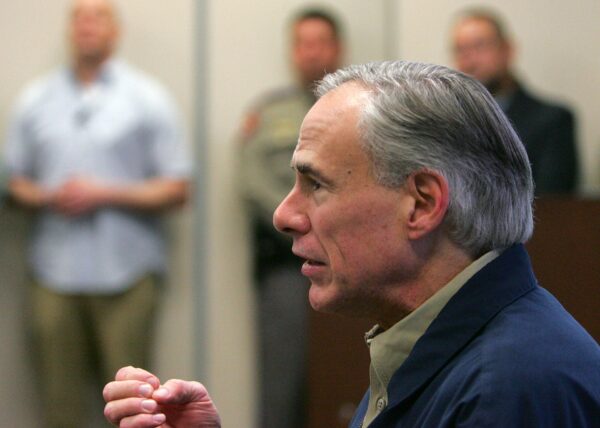
Texas Gov. Greg Abbott argued Monday that he is not legally required to surrender an Immigration and Customs Enforcement officer charged by Minnesota authorities with shooting a Venezuelan man during “Operation Metro Surge.”
Minnesota is asking a federal court to force the extradition of ICE officer Christian Castro, insisting that Abbott has no authority to refuse to sign the necessary warrant. A key hearing in the escalating legal fight is scheduled for Tuesday.
Abbott’s attorneys argued that Minnesota’s determination to prosecute Castro does not justify cutting short the governor’s ongoing consideration of the extradition request.
“In the end, Minnesota’s zeal to see Mr. Castro prosecuted on its home turf cannot justify pretermitting Governor Abbott’s ongoing deliberations pursuant to the Constitution and state statutes, which are designed to protect against abusive and baseless deprivations of individual liberty,” Abbott’s lawyers wrote.
U.S. District Judge Fernando Rodriguez Jr., an appointee of President Donald Trump, is set to consider Minnesota’s request during a Tuesday afternoon hearing in Brownsville, Texas.
The dispute has become a major showdown between Abbott and Democratic Minnesota Gov. Tim Walz, who requested Castro’s extradition after state officials charged the officer with four counts of second-degree assault and one count of falsely reporting a crime.
Castro is accused of shooting a Venezuelan man in the leg at the front door of an occupied Minneapolis home on Jan. 14 as immigration enforcement activity surged across the Twin Cities.
The officer allegedly told investigators that he fired in self-defense after being struck with a shovel and broom. However, authorities contend that video footage undermined Castro’s account of the incident.
Abbott has so far refused to sign a rendition warrant that would clear the way for Castro to be transported back to Minnesota to stand trial.
In Monday’s filing, Abbott’s lawyers questioned whether Castro qualifies for extradition under the Constitution. The extradition provision requires states to return criminal defendants who “flee from Justice” and are later “found in another State.”
Abbott has suggested that Castro did not flee Minnesota because ICE directed him to return to Texas.
“The ordinary meaning of a fugitive entails a volitional act of fleeing, not mere involuntary movement across state lines,” the governor’s attorneys wrote.
Minnesota argues that Abbott’s role in the extradition process is merely ministerial and is asking the court to immediately authorize Castro’s return.
State attorneys said the Constitution’s framers and Congress intended interstate extraditions to occur through a “swift, summary” process in which a state promptly returns a fugitive after receiving a demand from another state.
Abbott has emphasized that he has not made a final decision on Minnesota’s request. His attorneys nevertheless argued that Minnesota’s claim that it can unilaterally enforce the extradition power is “doomed to fail.”
The filing also criticized Walz for pardoning a man charged with sexually assaulting a minor.
“Equity favors those with clean hands,” Abbott’s lawyers wrote.
[READ MORE: 49ers Owner Jed York Pleads No Contest After Ohio Arrest]