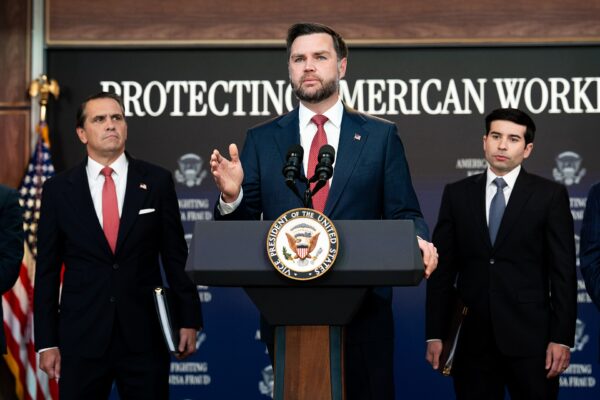
Vice President JD Vance is still keeping his 2028 options open after a rough midterm cycle for Republicans. A new report says he won’t make a final decision until next year.
Axios’ Alex Isenstadt reported Sunday, citing two sources familiar with Vance’s plans, that the vice president “won’t make a final decision on whether to run for president in 2028 until after the new year.” He may wait until late spring to announce his intentions publicly.
Vance has long been seen as the early favorite to succeed Trump as the Republican nominee. Isenstadt noted, though, that the party’s midterm losses have “complicated his political future.”
His team is not backing down. According to the report, Vance’s allies say the losses haven’t changed his status as the GOP front-runner, pointing to his donor network, political infrastructure and name recognition.
“Closest political advisers believe he should run in 2028 and that he’s likely to do so,” according to a person close to the vice president.
A Vance spokesperson declined to comment to Axios.
The report follows a tense stretch between Vance and parts of the MAGA movement. The morning after the election, the vice president posted a long, blunt postmortem blaming the Iran war for the GOP’s midterm collapse.
Critics saw the post as an attempt to protect his own 2028 prospects, which many observers believe took a bigger hit than those of other likely contenders. Some conservative commentators called the post disloyal to the president.
Trump himself appeared unhappy. He told reporters that “a lot of people didn’t like his comments.”
The episode raised new questions about whether Trump will back his vice president in a primary. Trump has said publicly that he likes both Vance and Secretary of State Marco Rubio as possible successors. Rubio has said he would not run against Vance.
The Ohio Republican, 42, was first elected to office in 2022, when he won a U.S. Senate seat. He served only part of that term before Trump picked him as his running mate in 2024.
The midterms also brought bad news for Vance’s former seat. Sen. Jon Husted, R-Ohio, who was appointed to finish Vance’s term, lost to former Democratic Sen. Sherrod Brown this month.
Vance said earlier this year that he and his wife, second lady Usha Vance, would not seriously discuss a presidential run until after the midterms. He has said he tries not to make major decisions until he absolutely has to.
With the midterms over, the clock is ticking. Any delay leaves room for rivals to build their own networks. But Vance’s backers believe his early advantages, including fundraising, staff and a national profile, will hold until he decides.
For now, the vice president appears content to let the dust settle before making his move.
[READ MORE: Trump Says He Would Have No Objection to Huang’s Return as Nvidia CEO]