Investment guru Larry McDonald issued a stark warning about the bond market Tuesday, telling Fox Business anchor Cheryl Casone that current conditions look “very similar to the summer of ’87” — while stressing he was not predicting another market crash.
McDonald made the comments after Casone asked for his reaction to newly released import and export price data.
Casone noted that import prices fell four-tenths of a percent month over month, compared with expectations for a one-tenth-percent increase. Export prices declined 1.3% month over month despite expectations for a two-tenths-percent gain, while the year-over-year figure came in at 5.9%.
Casone pointed to the potential implications for American consumers and companies, particularly against the backdrop of tariffs.
“We’re getting diminishing returns on the tariffs,” McDonald responded before turning his attention to the global bond market.
McDonald said rising yields are not limited to the United States, pointing to Japan, the United Kingdom and France as part of a broader global trend.
The concern for investors, he explained, is that when interest rates increase, bond prices fall. Eventually, however, bonds can begin offering returns attractive enough to compete with stocks for investors’ money.
McDonald warned that the shift could create additional risks during an already challenging seasonal period for markets.
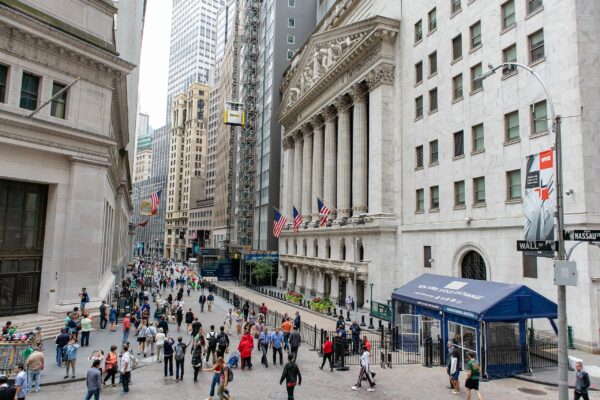
“It’s very similar to the summer of ’87,” McDonald said. “I’m not saying we’re going to crash,” he emphasized, before warning that investors should exercise “extreme caution” when bonds begin threatening stocks to this degree, particularly as rates rise across the G7.
The comparison referenced the period leading up to the Black Monday market crash in October 1987.
Casone then pressed McDonald on what investors could do in response to the “red flashing signals” he was describing.
McDonald pointed to Warren Buffett’s large cash position before highlighting companies that control hard assets as an alternative.
He said that could include businesses tied to oil and gas, metals and uranium, specifically mentioning BHP.
McDonald argued that companies controlling hard assets represent a relatively small portion of the broader market. He estimated roughly $41 trillion in the Nasdaq 100 compared with only around $4 trillion to $4.5 trillion across companies involved in metals, oil and gas, materials and industrials.
“So that’s the alternative: stay away from the crowded trade when bonds become this kind of a threat,” McDonald said.
Casone then turned briefly toward Nvidia, calling it another example of a “crowded trade,” before wrapping up the interview.
“Larry, it’s great to see you,” Casone said. “Larry McDonald, always fascinating to talk to you.”
[READ MORE: Former John Cornyn Staffer Jumps to Democrat James Talarico’s Texas Senate Campaign]