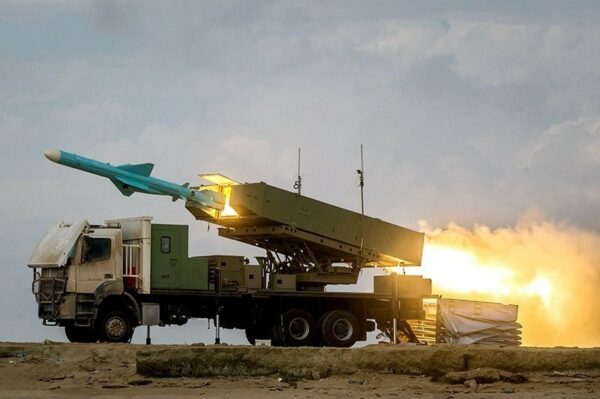
Iran’s Islamic Revolutionary Guard Corps (IRGC) claimed Monday that two oil tankers exploded after attempting to transit the Strait of Hormuz through what it described as an “unsafe route,” according to Iran’s state-run Fars News Agency.
The IRGC said the vessels exploded after trying to enter and exit the strategic waterway outside of designated shipping routes. According to Fars News Agency, the tankers had been “instigated and forced by the United States” to enter the strait in violation of established navigation channels.
The report did not provide additional details about the vessels or the explosions.
In a statement carried by the Iranian outlet, the IRGC accompanied its claims with a quotation from the Quran.
“If they break their oaths after their covenant and attack your religion, then fight the leaders of disbelief; indeed, they have no oaths; perhaps they will cease,” the statement said.
The IRGC also declared that “this is our land” and asserted that the “terrorist American army from thousands of kilometers away has no legal legitimacy and will definitely be confronted.”
The claims come as tensions continue to rise across the region following renewed hostilities between the United States and Iran.
Separately, Iran-backed Houthi militants in Yemen announced what they described as a naval blockade targeting Saudi Arabia, according to Reuters.
Reuters reported that Iran had called on the Houthis to block the Bab el-Mandeb Strait, which connects to the Red Sea, if the United States continued striking Iran’s electrical infrastructure.
The Houthis announced they were imposing “a maritime embargo against the criminal Saudi enemy, based on the equation of ‘an eye for an eye,’ effective immediately,” according to a statement cited by Reuters.
Reuters reported that closing the Bab el-Mandeb Strait would reduce the world’s oil supply by approximately 7% while preventing most Saudi oil exports from leaving the Middle East. The disruption would add to existing interruptions in the flow of oil through the Persian Gulf, where exports have already declined by roughly 10% since the conflict began.
The developments follow Iran’s decision to shut down the Strait of Hormuz after fighting resumed last week between the IRGC and U.S. forces.
According to the report, the renewed conflict effectively ended an interim agreement between the United States and Iran that had reopened the vital shipping lane and helped ease elevated gasoline prices.
Despite the ongoing military operations, diplomatic efforts appear to be continuing.
Reuters reported that a senior Iranian official said Tehran had received a proposal from mediators calling for a 10-day ceasefire in an effort to preserve the agreement.
The report added that both the United States and Iran have indicated they remain interested in pursuing diplomacy, even as U.S. military operations continue.
On Sunday, U.S. Central Command announced it had completed its latest round of strikes targeting Iranian military command centers, air defense positions, coastal surveillance sites, maritime capabilities, missile and drone launch locations, and communications networks.
Military operations intensified after two U.S. service members were killed in strikes in Jordan. The attacks also left one additional service member missing.
Separately, a “controlled detonation” involving a downed Iranian one-way attack drone in northern Iraq killed a third U.S. service member over the weekend.
According to the report, the latest fatality brings the total number of U.S. service members killed during the conflict to 17.
[READ MORE: Vice President JD Vance, Wife Usha Announce Birth of Fourth Child]