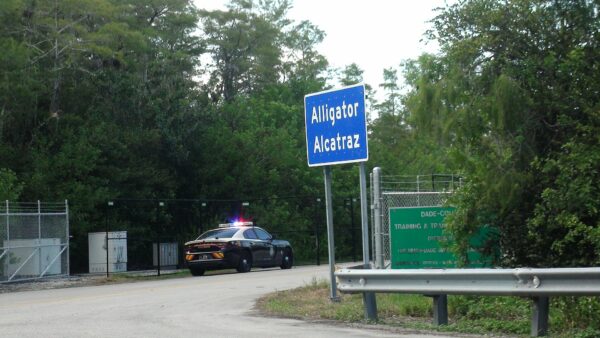
Florida’s high-profile migrant detention center known as “Alligator Alcatraz” appears to be entering its final chapter, with contractors reportedly instructed to begin dismantling the temporary facility nearly one year after it first opened.
The state-funded and operated detention center, which has drawn both praise and legal challenges since its launch in July 2025, is now undergoing what officials described as a “full demobilization.” The move signals the likely end of a project that has cost approximately $1.2 billion, while also underscoring state officials’ insistence that the facility was always intended to serve as a temporary measure rather than a permanent installation.
According to CBS News Miami, contractors overseeing operations were recently informed they should begin the full shutdown process. The New York Times similarly reported that Florida emergency management officials directed contractors to begin dismantling the site and make “significant progress” by Wednesday.
The effort comes less than a week after detainees housed at the facility were transferred to other detention locations. U.S. Immigration and Customs Enforcement officials said the relocations were carried out as a safety precaution as Florida enters hurricane season.
Despite the evacuation, an attorney representing environmental groups challenging both the DeSantis and Trump administrations over the facility said lighting, fencing, and tents remained in place after detainees were removed. By Monday, however, attorney Paul Schwiep said workers appeared to have begun deconstructing portions of the site.
Questions remain about the facility’s future. A spokesperson for Gov. Ron DeSantis referred requests for comment to the Florida Division of Emergency Management, the agency responsible for operating the site since it opened. The agency did not respond to requests seeking confirmation of the reported shutdown or its long-term plans for the property.
Florida Attorney General James Uthmeier also stopped short of confirming the reports but acknowledged that the number of detainees being sent to the facility had steadily declined in recent months.
“I think Alligator Alcatraz actually stayed open longer than it was intentionally planned when it was first conceptualized,” Uthmeier told reporters, adding that the detention center “was never meant to be a long-term project.”
According to Uthmeier, the facility’s purpose diminished as federal authorities expanded their own immigration enforcement capabilities.
“Now that the federal government is resourced and standing up its own mission, using its own authorities, [the Florida site] is no longer needed,” he said. “The plan was always to protect the Everglades and take it back (to being a) protected area.”
CBS News Miami reported that removing the remaining infrastructure could take several weeks before the property is once again available for pilot training operations at Dade-Collier Training and Transition Airport.
Schwiep, however, questioned ICE’s explanation that detainees were moved because of hurricane season. He noted that the detention center was originally built during last year’s hurricane season and that detainees were housed there shortly after construction.
When the facility opened, Florida emergency management director Kevin Guthrie said it was designed to withstand Category 2 hurricane winds of up to 110 mph. CBS News reported Guthrie told contractors Monday that he expected substantial progress in clearing the site by Wednesday. Just last week, Guthrie had stated that emergency management officials had not been instructed to stand down and that the facility remained prepared to receive additional detainees, according to The Miami Herald.
Although Schwiep welcomed the removal of detainees, citing what he described as inadequate power and sewage infrastructure, he said the pending lawsuit remains active. He argued the objective has always been to ensure the property is restored after its temporary use concludes.
Florida officials have emphasized that the federal government reimbursed the state for the project. In May, Florida received the first reimbursement payment of $58.2 million as part of a promised total of $608 million connected to operating the facility.
Last week, DeSantis declined to confirm reports that the center would permanently close but defended its record. He said the facility improved public safety by detaining criminal migrants who otherwise could have been released into Florida communities.
According to the governor, the detention center has housed as many as 25,000 detainees since opening while costing more than $1.2 million per day to operate. Built in less than a week, the remote facility was also viewed by Department of Homeland Security officials as a potential model for similar operations in other states. While its mission now appears to be ending, state officials maintain it fulfilled the temporary purpose for which it was created.
[READ MORE: Trump Mocks George Conway After Congressional Bid Ends in Distant Fifth Place]