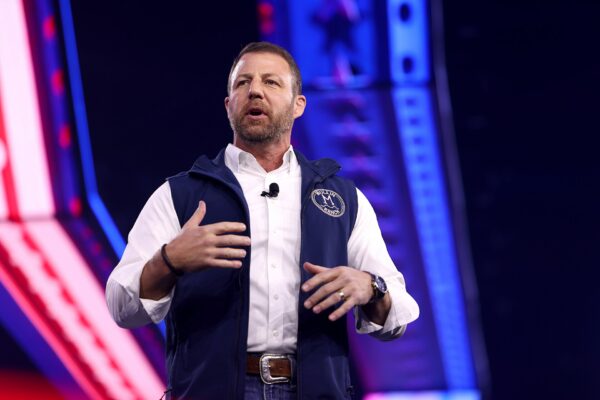
Homeland Security Secretary Markwayne Mullin reportedly said Tuesday night that the Trump administration is considering a dramatic escalation in its battle with sanctuary cities, revealing officials are “drawing up plans” that could halt the processing of international flights in cities accused of obstructing federal immigration enforcement.
The remarks came during a Fox News appearance following days of protests outside the Delaney Hall immigration detention center in Newark, New Jersey, where demonstrators have clashed with immigration authorities and Sen. Andy Kim was reportedly pepper sprayed during an encounter with ICE agents.
Mullin argued that local officials in sanctuary jurisdictions are creating unsafe conditions for federal employees while simultaneously relying on the federal government to handle international arrivals at nearby airports.
“They’re barricading our employees from coming in and out of the facility,” Mullin said. “Then, why are we processing international flights into the airport there?”
The DHS chief said the administration has not yet initiated the policy but confirmed discussions are underway.
“We are currently — which we’re not initiating yet — but we’re currently drawing up plans to say, listen, these sanctuary cities where the local radical-left Democrats aren’t allowing us to do our jobs and enforce federal laws, then we shouldn’t be processing international flights into their cities either,” he continued.
“Because they don’t want us to enforce immigration, but they want us to process immigration at their facilities. Nothing about that makes sense to me.”
The proposal immediately triggered criticism from immigration advocates and former federal officials, who warned such a move could unleash massive disruption across the nation’s air travel system without significantly affecting immigration policy itself.
Under current procedures, agents with U.S. Customs and Border Protection process international arrivals by checking passports, visas, permanent residency documentation, and other forms of legal authorization to enter the country. CBP officers handle both American citizens returning home and foreign travelers arriving on tourist, work, or residency visas.
Critics argued that suspending international processing at major airports would not simply reroute planes elsewhere, but could instead trigger widespread flight cancellations affecting both Republican- and Democrat-leaning regions alike.
Juliette Kayyem, who served in the Obama-era Department of Homeland Security, mocked the proposal on social media, suggesting the idea would create chaos while doing little to change immigration realities on the ground.
“Of all the bad ideas floated by this Administration, this one ranks,” Kayyem wrote on X.
“It has got to be real; Mullin wouldn’t waste time like this unless it is a serious distraction plan,” she added. “Planes don’t divert to other airports. The flights will be cancelled, disrupting blue and red voters, impacting the airlines, and having no impact on immigration policy.”
Aaron Reichlin-Melnick also condemned the idea, calling it “actively insane.”
“Airlines cannot divert large numbers of international flights from one city to another,” he wrote on X. “They’d just have to cancel flights en masse, causing enormous economic damage.”
The comments reflect the increasingly confrontational tone surrounding immigration enforcement as the Trump administration intensifies its push against sanctuary city policies and public resistance to ICE operations. At the same time, the growing standoff highlights how battles over immigration enforcement can quickly spill beyond detention centers and into broader questions about commerce, travel, and the federal government’s use of power.
As protests continue outside Delaney Hall, the administration appears determined to send a message that jurisdictions resisting federal immigration enforcement may face consequences extending far beyond the border itself.