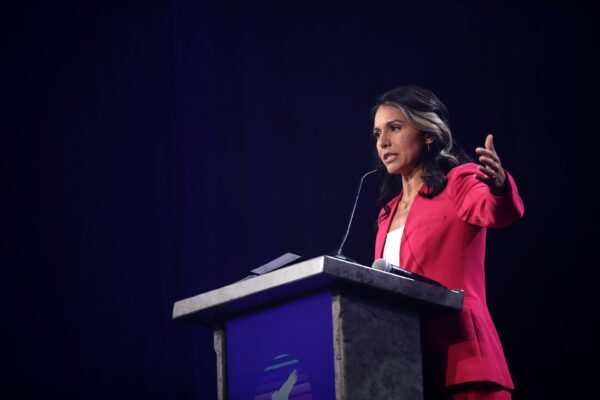
Director of National Intelligence Tulsi Gabbard on Monday unveiled newly declassified materials that she says shed light on how the intelligence community handled the events that ultimately led to the 2019 impeachment of President Donald Trump.
According to the release, the documents point to what Gabbard described as a coordinated effort involving elements within the Intelligence Community, including former Inspector General Michael Atkinson, to advance a whistleblower complaint that became central to the impeachment proceedings.
The materials indicate that Atkinson’s preliminary review relied heavily on second-hand information. His inquiry included interviews with four individuals: the whistleblower, a colleague identified as a co-author of the 2017 Intelligence Community Assessment on Russia, and two additional witnesses who reportedly lacked direct knowledge of the July 2019 phone call between Trump and Ukrainian President Volodymyr Zelensky.
Despite the absence of firsthand evidence, the documents state that the complaint was deemed credible and classified as an “urgent concern,” ultimately being transmitted to Congress and referred to federal authorities. The Justice Department later concluded there was no basis for a criminal case, determining that no campaign finance violation had occurred and that no further action was warranted.
Gabbard argued that the process represented a misuse of established procedures, claiming that standard protocols were not followed and that second-hand accounts were elevated beyond their evidentiary value. She further contended that the whistleblower process was effectively weaponized, raising concerns about how intelligence mechanisms can be used in highly charged political environments.
The release also highlights statements from the whistleblower acknowledging a lack of direct knowledge of the president’s call. Additional witness interviews suggest that interpretations of the call were, in some cases, formed after the fact, with one individual stating that conclusions required “reading between the lines.”
Questions surrounding potential bias are also addressed in the documents. The whistleblower is described as having acknowledged being a registered Democrat and having prior professional interactions involving then–Vice President Joe Biden on Ukraine-related matters. The materials also state that the whistleblower initially failed to disclose contact with congressional staff prior to filing the complaint, later confirming that such communication had occurred.
Newly-declassified records expose how deep state actors within the Intelligence Community concocted a false narrative that Congress used to usurp the will of the American people and impeach duly-elected President @realDonaldTrump in 2019.
Today, we reveal the truth 👇… pic.twitter.com/oLXW5nqi2n
— DNI Tulsi Gabbard (@DNIGabbard) April 13, 2026
Gabbard additionally pointed to the involvement of a witness tied to the 2017 Russia assessment, which she characterized as flawed, arguing that reliance on such sources further undermined the credibility of the initial complaint.
Another key issue raised in the documents is the handling of evidence during the early stages of the inquiry. Despite knowing a transcript of the Trump-Zelensky call existed, Atkinson did not request access to it during the preliminary review, according to the release.
The documents also note that the Department of Justice advised that the complaint did not meet the statutory definition of an “urgent concern.” Nevertheless, the complaint was forwarded to Congress, where it became a central component of impeachment proceedings led at the time by House leadership, including then-Intelligence Committee Chairman Adam Schiff and then-Speaker Nancy Pelosi.
Gabbard framed the release as part of a broader push for transparency, arguing that exposing these processes is essential to maintaining public trust. The episode, while rooted in domestic political conflict, also reflects how high-stakes decisions—whether in governance or international affairs—can carry lasting consequences when shaped by incomplete or disputed information.