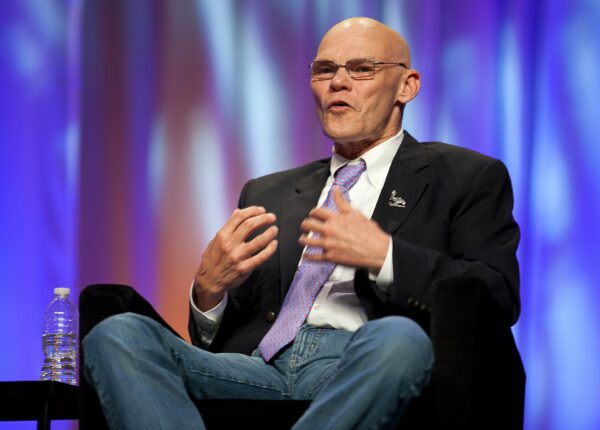
Veteran Democratic strategist James Carville is forecasting a dramatic political clash in the years ahead, warning that President Donald Trump could ultimately be pressured into making a deal and stepping aside amid mounting investigations following the 2026 midterm elections.
In a video posted Tuesday, Carville laid out a blunt and combative vision of what he believes Democrats will pursue if they gain the political momentum they are hoping for. His remarks painted a picture of aggressive oversight not only targeting the president himself, but extending to his family and close associates.
Carville suggested that Democratic leaders, including Sheldon Whitehouse, Hakeem Jeffries, and Chuck Schumer, would initially present a public posture of cooperation before pivoting toward sweeping investigations. He mocked the idea of bipartisan unity, predicting instead that Democrats would move quickly to scrutinize what he alleged to be financial wrongdoing tied to Trump and his inner circle.
According to Carville, that scrutiny would not stop with the president. He claimed Democrats would also examine Trump’s children and their spouses, signaling a broad and deeply personal political battle. His comments underscored the increasingly hard-edged tone that has defined Washington in recent years, where political disputes often spill beyond policy disagreements into personal and legal arenas.
The strategist also tied his prediction to the administration’s foreign policy decisions, particularly ongoing tensions involving Iran. He warned that actions taken during the conflict could expose the president to serious international legal risks, suggesting the possibility of crossing into territory that could draw scrutiny from courts abroad. While such claims remain speculative, they reflect the heightened stakes surrounding U.S. military engagement and the legal questions that can follow decisions made during wartime.
At the same time, Carville pointed to Trump’s legal history following his first term as part of his broader argument. The president previously faced multiple indictments, including business fraud charges brought by Alvin Bragg, as well as cases tied to his efforts to challenge the 2020 election results led by Jack Smith and Fani Willis. Those past legal battles, Carville implied, could foreshadow future confrontations if political control shifts in Washington.
In one of his more pointed assertions, Carville predicted that Trump would eventually “cut a deal” and resign, with Vice President J.D. Vance stepping in and issuing a pardon. He argued, however, that such a move would not shield the president from all potential legal exposure, noting that presidential pardons do not extend to state-level charges or international proceedings.
The remarks highlight a broader reality in today’s political climate: the intersection of domestic politics, legal accountability, and foreign policy decisions is becoming increasingly difficult to separate. While supporters of the administration continue to defend its actions as necessary for national security and law enforcement, critics are preparing for a prolonged fight that could stretch well beyond the ballot box.
Even as these predictions remain uncertain, they point to a future where political divisions deepen and the consequences of both policy and war are debated not only in Congress, but potentially in courtrooms at home and abroad.