Former Democratic strategist Dan Turrentine said Monday that Rep. Alexandria Ocasio-Cortez’s response to a foreign policy question at the Munich Security Conference exposed what he described as a lack of preparedness for a potential presidential run.
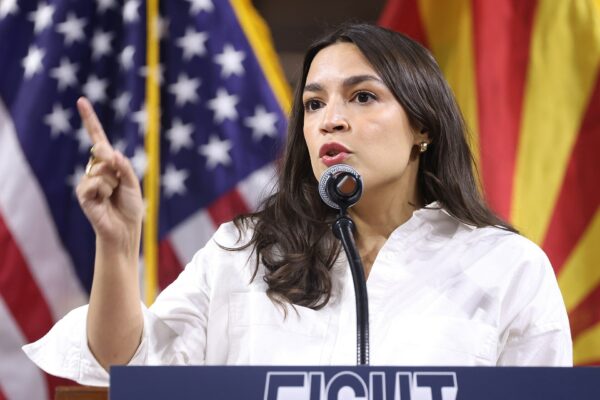
The controversy stems from a 40-second answer Ocasio-Cortez gave Friday when Bloomberg Television’s Francine Lacqua asked whether the United States should send troops to protect Taiwan if China were to invade the island. The New York Democrat’s response, marked by pauses and halting phrasing, quickly drew attention online.
Appearing on “The Huddle,” Turrentine argued the moment underscored the difference between domestic political rallies and the global stage.
“What it was a reminder of is you’re now on the big stage. This is not a union hall in Queens,” Turrentine said. He noted that Ocasio-Cortez’s team had promoted her appearance at the high-profile conference.
“She froze like a deer in headlights,” he added, referencing comparisons online to former Vice President Kamala Harris. “I don’t think this is going to end her career. But what I found fascinating was how she and her team reacted. She canceled media appearances on Saturday. There was nobody online defending her.”
Turrentine said that even on left-leaning platforms, Ocasio-Cortez did not receive the kind of rapid, organized defense that other prominent figures often enjoy.
“Even on the left, if you went to Bluesky, there were not kind of — like if President Donald Trump does something like this … if you even so much as mock him, comes back at you with a baseball bat,” Turrentine said. “She had no defenders. She froze not just on the stage, but she froze off the stage and basically slinked back to the United States. And to me, that was a sign that she is not ready for this.”
CNN reported that Ocasio-Cortez’s team limited her public and media appearances following the Taiwan exchange.
In her original answer, Ocasio-Cortez said, “You know, I think that — uh — this is such a — you know, I think that this is a — this is, of course a — uh — a very long standing policy of the United States.” She continued, “And, I think what we are hoping for is that we want to make sure that we never get to that point.”
“And we want to make sure that we are moving in all of our economic research and our global positions to avoid any such confrontation and for that question to even arise,” she added.
The moment has taken on added significance as speculation grows about Ocasio-Cortez’s political future. During the same conference, New York Times reporter Katrin Bennhold framed a question with the phrase “when you run for president.”
“So when you run for president, are you going to impose a wealth tax or a billionaire’s tax?” Bennhold asked.
“I don’t think that we have to wait for any one president to impose a wealth tax,” Ocasio-Cortez replied, declining to directly address whether she intends to seek the White House in 2028.
This is not the first time the congresswoman has faced scrutiny over foreign policy. During her first campaign for Congress in 2018, she said, “I’m not the expert in geopolitics,” when pressed to clarify remarks about the Israeli “occupation” of Palestine.
For Turrentine, the Munich exchange was less about one question and more about what it revealed. On a global stage where foreign policy answers carry serious weight, he suggested, the episode signaled that Ocasio-Cortez may not yet be ready for a presidential spotlight.
[READ MORE: Massie Criticizes Bondi’s Epstein Testimony, Says Garland ‘Performed Better’]