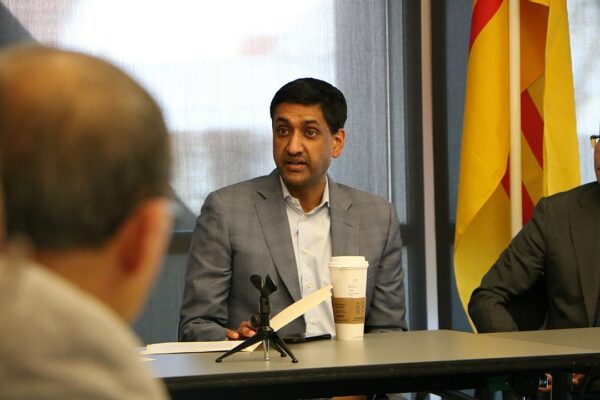
Rep. Ro Khanna, D-Calif., took to the House floor Tuesday to publicly name six wealthy men he claims were implicated in the crimes of convicted sex offender Jeffrey Epstein, accusing the Trump Justice Department and the FBI of improperly shielding powerful figures from scrutiny.
Khanna said he and Rep. Thomas Massie, R-Ky., personally traveled to the Department of Justice to review what lawmakers were told were “unredacted” Epstein files. According to Khanna, after spending roughly two hours reviewing the material, they discovered that the vast majority of the records were still heavily censored.
“We learned that 70 to 80 percent of the files are still redacted,” Khanna told lawmakers. “In fact, there were six wealthy, powerful men that the DOJ hid for no apparent reason.”
Khanna claimed that after he and Massie raised objections, the Justice Department acknowledged an error and disclosed the identities of those six men. Khanna then read the names into the Congressional Record: Salvatore Nuara, Zurab Mikeladze, Leonic Leonov, Nicola Caputo, Sultan Ahmed Bin Sulayem, and Leslie Wexner. Khanna noted that Wexner had been labeled a co-conspirator by the FBI in Epstein-related records.
Sultan Ahmed Bin Sulayem is the CEO of Dubai Ports World, while Leslie Wexner is a billionaire businessman long linked to Epstein. Khanna questioned why it took two members of Congress personally reviewing the files to force the disclosure.
“If we found six men they were hiding in two hours,” Khanna said, “imagine how many men they are covering up for in those three million files.”
Khanna went further, accusing Federal Bureau of Investigation of scrubbing the files months earlier, before he and Massie passed the Epstein Transparency Act. He said the Justice Department told them it simply uploaded whatever material the FBI provided.
“And guess what?” Khanna said. “The FBI sent scrubbed files.”
According to Khanna, that meant survivor statements identifying wealthy and powerful men who allegedly visited Epstein’s island, ranch, or homes were obscured. He claimed those names were redacted despite the law requiring only victim information to be protected.
Khanna insisted the issue went beyond paperwork and amounted to a deeper failure of accountability. He accused the FBI of effectively concealing the identities of men he said were part of Epstein’s network and criticized what he described as a performative process that invites lawmakers to review files that remain largely censored.
Khanna framed the issue as part of a broader problem of unequal justice, arguing that elites are protected while ordinary Americans face consequences. He contrasted the U.S. situation with actions taken abroad, then pivoted back to domestic concerns, including references to individuals he said appeared in Epstein files while remaining politically powerful.
Throughout his remarks, Khanna repeatedly returned to the theme of what he called “elite accountability,” arguing that wealthy and influential figures should not be immune from investigation or prosecution.
The California Democrat closed by tying the Epstein case to wider economic grievances, saying the country operates under “two tiers of justice” and claiming that wealth and power shield certain individuals from consequences. He called for congressional investigations, prosecutions where warranted, and a return to what he described as equal justice under the law.
While Khanna’s speech was charged and sweeping, it underscored growing bipartisan frustration over the handling of Epstein records and renewed demands from lawmakers across the spectrum for transparency and accountability in one of the most notorious criminal cases in modern history.
[READ MORE: House Passes Sweeping Bipartisan Housing Bill to Tackle Affordability Crisis]