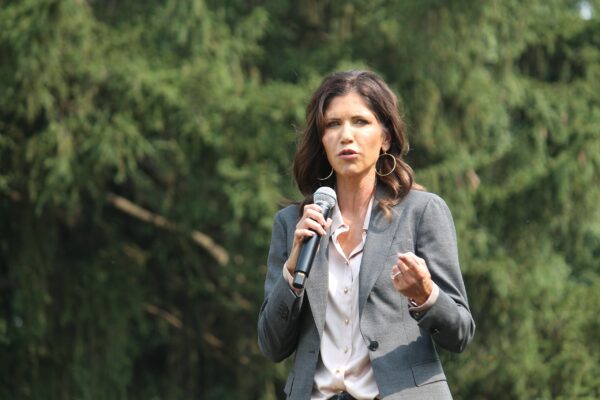
Homeland Security Secretary Kristi Noem announced Monday that body cameras will be deployed to all federal agents under the Department of Homeland Security operating in Minneapolis, a move that aligns with demands from protesters and Democratic lawmakers following intense scrutiny of federal immigration enforcement tactics.
The decision comes amid widespread criticism of enforcement actions carried out during President Donald Trump’s immigration crackdown, which has sparked protests across the country. Those demonstrations intensified after two fatal shootings of U.S. citizens in Minneapolis involving federal immigration agents earlier this year.
On Jan. 7, Renee Good was fatally shot by Immigration and Customs Enforcement agent Jonathan Ross. Weeks later, on Jan. 24, Alex Pretti was killed in a separate incident involving Border Patrol agent Jesus Ochoa and Customs and Border Protection officer Raymundo Gutierrez. Both shootings became flashpoints in the national debate over immigration enforcement and accountability.
In each case, video footage captured by witnesses contradicted initial claims made by Trump administration officials, according to critics. That footage has been repeatedly cited by those calling for sweeping changes to federal immigration enforcement, including demands that agents be prohibited from wearing masks and be required to use body cameras during operations.
Monday afternoon, Noem announced the policy shift on social media, saying she had spoken with Tom Homan, Trump’s border czar, who was recently sent to oversee the situation in Minneapolis. Homan was deployed after Border Patrol Commander Greg Bovino was removed from his post and sent back to California.
Noem said she and Homan agreed that, “effective immediately,” body cameras would be deployed to every DHS officer working in the field in Minneapolis. She added that the department plans to expand the program nationwide as funding becomes available.
“As funding is available, the body camera program will be expanded nationwide,” Noem said. “We will rapidly acquire and deploy body cameras to DHS law enforcement across the country.”
The announcement was quickly framed by media outlets as a partial concession to Democratic demands. CNN anchor Kasie Hunt noted that the move comes as Democrats have been attempting to use ongoing government funding negotiations to force changes to Immigration and Customs Enforcement policies and tactics, with body cameras being a central demand.
CNN chief congressional correspondent Manu Raju echoed that assessment, saying the push for mandatory body cameras has been a major priority for Democrats on Capitol Hill. Raju described the move as “a step towards the direction that Democrats have been demanding,” while emphasizing that Democrats are seeking far more extensive changes.
According to Raju, beyond body cameras, Democrats want ICE officers to remove their masks, revise how judicial warrants are issued, alter use-of-force policies, and end roving patrols conducted by immigration agents. He noted that those demands go significantly further than what many Republicans are willing to support.
Raju added that while those broader issues are likely to be the subject of future political battles, the immediate dispute centers on funding the federal government. The body camera announcement, he suggested, represents just one piece of a much larger and ongoing negotiation between the White House and congressional Democrats.
For now, Noem’s directive marks a significant operational change in Minneapolis, as DHS seeks to respond to mounting pressure following the deadly incidents and the national backlash that followed.