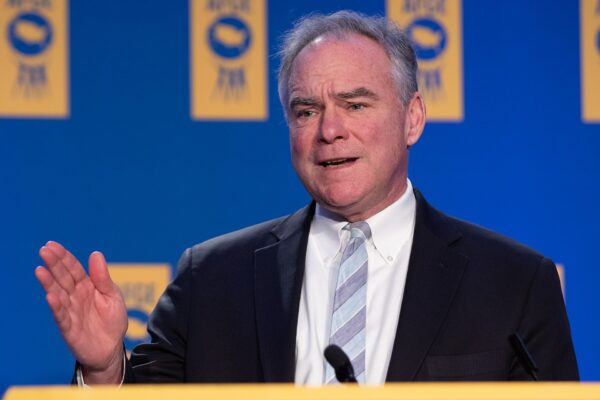
Sen. Tim Kaine sharply challenged Secretary of State Marco Rubio on Wednesday, accusing the Trump administration of shielding key legal reasoning and evidence tied to U.S. military operations in the Caribbean and Venezuela from public view.
Rubio appeared before the Senate Foreign Relations Committee more than five months after President Donald Trump authorized a major military campaign targeting suspected drug-trafficking vessels in the Caribbean, and roughly a month after U.S. forces captured Venezuelan President Nicolás Maduro. Kaine used the hearing to question why details surrounding those actions remain classified.
“Why is the administration and the majority in the Senate so jealously protecting the details about it from being revealed to the American public?” Kaine asked. He complained that the legal justifications and supporting evidence for the operations are locked behind classification barriers.
Kaine said the secrecy has left him unable to answer questions from constituents whose family members are deployed as part of the mission. “I have Virginians deployed in this operation,” he said. “I can’t answer their families’ questions.”
The Virginia Democrat also took aim at the administration’s explanation for counter-narcotics strikes in the Caribbean. Concerns have been raised that U.S. forces may have committed war crimes by ordering additional strikes against survivors of boats that were already destroyed.
“I can’t share with you the grim details of the murder of shipwrecked survivors in open waters that we all know because we’ve seen the videos, and we’ve questioned the U.S. military officials involved about legality, because the administration will not release that publicly,” Kaine said.
He further alleged that information about a second strike, which killed survivors struggling in the water, was withheld from Congress for nearly three months. “They hid the second strike that killed struggling shipwreck survivors even from Congress for nearly three months, but I can’t really talk to you about it,” Kaine added.
Sen. Jeff Merkley of Oregon echoed Kaine’s criticism, arguing that the administration should commit to regular briefings for lawmakers. Merkley suggested Rubio should update the committee every six weeks, saying the lack of transparency suggests embarrassment rather than legitimate security concerns.
“I also feel like the strategy of keeping, basically, these very weak arguments secret,” Merkley said, “you will obviously be incredibly embarrassed that those were public.”
Merkley went on to frame the administration’s actions in stark terms. “And let’s be clear about what has gone on,” he said. “We had a dictator we didn’t like. We replaced it with a dictator we think we can manipulate.”
Rubio defended the administration’s actions, arguing that the operation in Venezuela was aimed at removing an indicted drug trafficker from power. He said supporting Delcy Rodríguez, Maduro’s deputy who is now serving as interim president, is intended to preserve stability while ultimately working toward a democratic transition.
The secretary used a medical analogy to explain the administration’s approach. Rubio likened Venezuela to a critically injured patient, saying the focus must first be on saving the country from immediate collapse.
Rubio compared the situation to treating someone with a broken leg and a ruptured spleen, arguing that urgent care must come before long-term recovery. “Even when you deal with a broken leg, there’s going to be a period of rehabilitation,” he said.
The exchange highlighted the growing tension between Democratic lawmakers demanding greater transparency and an administration determined to keep sensitive military and legal details classified as it pursues its strategy in the Caribbean and Venezuela.
[READ MORE: Trump Takes On Indiana Republicans Who Refused Redistricting]