Iran and its Houthi allies escalated their rhetoric against the United States this week as a U.S. Navy carrier strike group led by the USS Abraham Lincoln moved toward the Middle East, raising concerns about a broader confrontation if tensions continue to climb.
The warning from the Houthis came in the form of a short but ominous video released online. The footage showed an earlier Houthi attack on a commercial cargo vessel left burning at sea, accompanied by a single word: “Soon.” Observers interpreted the message as a potential signal that the Iran-backed group could resume attacks on shipping throughout the region, similar to the wave of assaults that followed the Oct. 7, 2023, Hamas attack on Israel.
Houthi military spokesman Brig. Gen. Yahya Saree reinforced the threat in a separate statement circulated online. Saree said the Houthis would not stand aside if a conflict widened to include Iran and vowed continued support for Hamas forces in Gaza. He warned that the group would back “any Arab or Islamic country” confronting what he described as Israeli aggression supported by the United States.
Iran delivered its own warning shortly afterward. Defense Ministry spokesman Gen. Reza Talaei-Nik said Monday that any military action by the United States or Israel would provoke a response “more painful and more decisive than in the past,” according to Iranian state-linked media.
Over the weekend, Iranian authorities unveiled a provocative banner in Tehran’s Enghelab, or Revolution, Square. The display depicted an American aircraft carrier covered in blood and bodies and carried the message, “If you sow the wind, you will reap the whirlwind.” The banner explicitly referenced the USS Abraham Lincoln, underscoring Tehran’s intent to send a direct signal as the carrier strike group approaches.
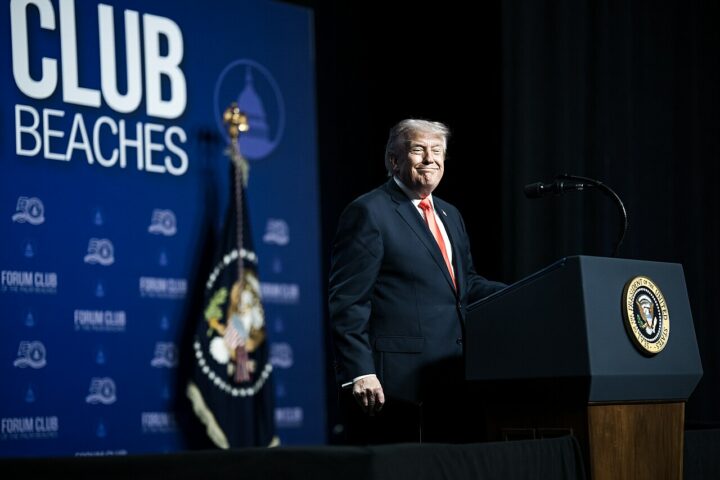
President Donald Trump has said the Lincoln is being redeployed “just in case” he decides to take action against Iran. Trump has previously warned that the United States would respond militarily if Tehran killed peaceful protesters or carried out mass executions of those detained during the ongoing crackdown.
For weeks, large-scale protests have spread across Iranian cities as citizens demonstrated against the regime. Security forces have responded with lethal force, according to opposition groups and human rights monitors, who estimate that roughly 4,000 protesters have been killed. Iranian authorities also imposed a near-total internet blackout for nearly two weeks, attempting to prevent images and video of the crackdown from reaching the outside world.
The unrest was initially sparked by severe economic conditions, including extreme inflation, a collapse in the value of the rial, and soaring prices for basic goods. Those pressures have intensified strain on the regime at a time when economic deterioration and recent regional setbacks have pushed Tehran to a breaking point.
Historically, periods of internal instability in Iran have increased the regime’s willingness to seek leverage abroad. That approach has often involved activating proxy forces capable of striking American, Israeli, or commercial targets across the region. Analysts say that pattern makes the current crisis especially dangerous, as Iran’s leadership faces few options that do not risk further weakening or collapsing its grip on power.
The movement of the USS Abraham Lincoln strike group is widely viewed as a deterrent signal aimed at discouraging Tehran and its allies from escalating. U.S. officials are concerned that a weakened or destabilized Iranian regime could lash out through its network of proxies, including the Houthis in Yemen and Hamas in Gaza, both of which are heavily funded, trained, and armed by Iran.
The U.S. military has not publicly responded to the latest threats. Still, the coordinated messaging from Tehran and its regional partners follows a familiar pattern in which Iran relies on proxy forces during moments of domestic vulnerability.
The arrival of the Abraham Lincoln is intended to complicate Iran’s calculations, signaling U.S. readiness to respond while reinforcing deterrence at what many see as the most precarious moment for Iran’s leadership in years.