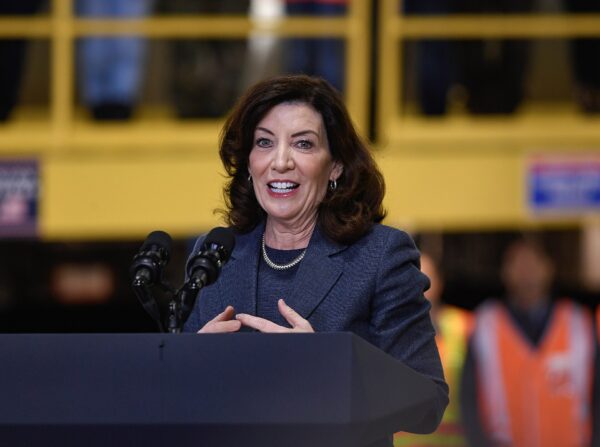
New York Gov. Kathy Hochul announced Thursday that she will include a “no tax on tips” proposal in her upcoming Executive Budget for fiscal year 2027, a move that closely mirrors a policy championed by President Donald Trump and Republicans — and one that comes as she prepares for a tough reelection fight this fall.
According to Hochul’s office, the proposal would exempt up to $25,000 in tipped income from New York state income taxes for the 2026 tax year. The plan would apply to workers who rely on gratuities as a core part of their income, including restaurant servers, bartenders, and other service industry employees.
“I’m kicking the new year off with a proposal of no state income tax on tips, continuing my efforts to make New York more affordable for hard working New Yorkers,” Hochul said in a statement. Her office added that the governor’s tax relief initiatives now total more than $9 billion since she took office.
The announcement comes after months of criticism from Republicans and the Trump administration, who accused Hochul and Democratic lawmakers in Albany of ignoring a popular affordability measure already enacted at the federal level. President Donald Trump made “no tax on tips” a centerpiece of his 2024 campaign, particularly while campaigning in Nevada, where the economy is heavily dependent on tourism and service-sector jobs. Former Vice President Kamala Harris later adopted the idea as well.
Last year, Republicans passed Trump’s sweeping GOP policy package, which included a federal “no tax on tips” provision. Under that law, tipped workers can deduct up to $25,000 in gratuity income if they earn up to $150,000 annually, or $300,000 for joint filers. The legislation also included a smaller deduction tied to overtime pay.
Despite that federal change, Hochul initially declined to extend the policy to New York’s state income taxes — a decision that drew sharp rebukes from the White House. Press Secretary Karoline Leavitt blasted the governor last week, accusing her of squeezing service workers while talking about affordability.
“Disgraceful,” Leavitt wrote on X, linking to a New York Post report. She said Hochul and Democratic lawmakers were “hitting bartenders and restaurant workers in the pocketbook all while preaching affordability.”
Now, with an election looming, Hochul appears to be reversing course.
The Democratic governor is seeking a second term in November and will face Nassau County Executive Bruce Blakeman, a Republican who secured Trump’s endorsement shortly after Rep. Elise Stefanik exited the GOP primary. Blakeman has aligned himself closely with Trump’s economic and public safety agenda, positioning himself as a check on one-party Democratic rule in Albany.
Still, Hochul enters the race with a significant advantage. A Siena College poll released in mid-December showed her leading Blakeman by 25 points, reflecting a broader political environment that currently favors Democrats heading into the midterm season.
Republicans acknowledge they face an uphill battle in deep-blue New York, but they argue Hochul’s sudden embrace of a Trump-backed tax policy underscores growing voter frustration over affordability, taxes, and the cost of living.
For critics, the timing is hard to ignore. What was once dismissed by Albany Democrats is now being repackaged as a signature budget item — just months before voters head to the polls.
Whether Hochul’s proposal survives the budget process remains to be seen. But one thing is clear: a policy born out of Trump’s 2024 campaign has now reshaped the debate in New York, forcing Democrats to follow a path Republicans say they should have taken all along.
[READ MORE: Trump Unloads on Clooney Over Politics, Citizenship Move, and Media Attacks]