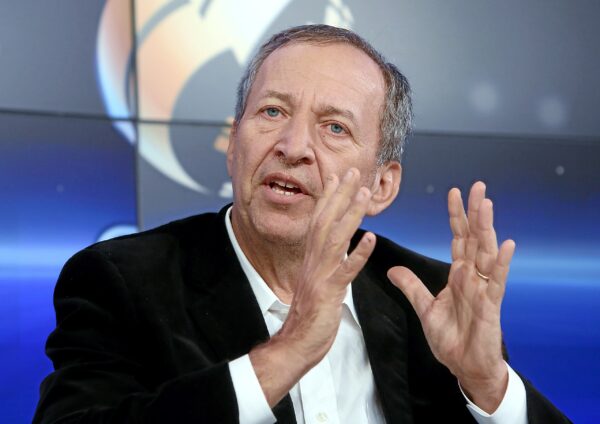
Former Treasury Secretary Larry Summers has now reportedly found himself back in the spotlight after newly released Justice Department documents revealed he was once listed as a successor executor in convicted sex offender Jeffrey Epstein’s will, further underscoring the depth of Epstein’s connections to powerful figures.
The disclosure came as part of a massive release of Epstein-related records by the Department of Justice. Among the documents was a 2014 will showing Summers named fourth in line to assume control over Epstein’s estate. According to the will, Summers would have gained authority only if the three primary executors failed to qualify or were unable to continue in the role.
Those primary executors were Darren K. Indyke, David Mitchell, and former Barclays executive James E. Staley. The document, first reported by The Harvard Crimson, makes clear that Summers was positioned as a backstop, not a lead figure, but his inclusion nonetheless adds to questions surrounding his past association with the disgraced financier.
The will specified that Summers would step in only if the original executors “fail[ed] to qualify or cease[d] to act.” That scenario never materialized. Epstein later updated his will in 2019, removing both Summers and Staley from any potential role in overseeing his estate while Epstein was serving a prison sentence.
Epstein died by suicide in August 2019 while in federal custody, a death that continues to fuel controversy and public distrust. The revised will meant Summers ultimately had no involvement in the administration of Epstein’s finances or estate.
A spokesperson for Summers told The Guardian that the former Treasury secretary had no knowledge he was named in an early version of the will. “Mr. Summers had absolutely no knowledge that he was included in an early version of Epstein’s will and had no involvement in his financial matters or the administration of his estate,” the spokesperson said.
Still, the revelation has renewed scrutiny of Summers’ past decisions and judgment. Summers, who also served as president of Harvard University, has acknowledged maintaining contact with Epstein even after the financier’s criminal conduct became public. That decision has drawn criticism from across the political spectrum.
“I am deeply ashamed of my actions and recognize the pain they have caused,” Summers said in a statement obtained by NewsNation, The Hill’s sister company. “I take full responsibility for my misguided decision to continue communicating with Mr. Epstein.”
In the wake of mounting criticism, Summers has largely stepped back from public-facing roles. He voluntarily resigned his membership in the American Economic Association and also withdrew from his teaching position at Harvard. These moves followed his departure from OpenAI and signaled a broader retreat from professional and academic commitments.
The latest disclosure reinforces what many Americans have long suspected: Epstein’s web of influence extended deep into elite political, academic, and financial circles. While Summers has denied any involvement in Epstein’s crimes or finances, his inclusion in the will — even unknowingly, as he claims — highlights how normalized Epstein’s presence had become among the powerful before his arrest.
As more Epstein-related documents continue to surface, each new revelation adds to public frustration over how figures in positions of authority failed to cut ties sooner or ask harder questions. For critics, the Summers episode serves as another reminder that accountability often arrives late, if at all, for those at the top — even when their judgment is deeply compromised.
[READ MORE: Megyn Kelly Accuses Shapiro and Weiss of Fueling Anti-Semitism Through Censorship Push]